Monthly Archives: May 2021

The Venn Diagram of Science Fiction and Fantasy Awards: 1970, Part Two

(I’ve been reading the stories that got both Hugo and Nebula nominations. To see all the posts in the series, check the “Joint SFF Nominations” tag.

Because this one was running long, I decided to split it into two parts. Before reading this you’ll want to check out the first half, which among other things includes the story list.)

Possession

Robert Silverberg’s “Passengers” isn’t as excruciatingly uncomfortable as “A Boy and His Dog” but isn’t great. In the story’s world incorporeal “Passengers” take people’s bodies on joyrides. (These sound more like drivers than passengers, but never mind.) Victims are conscious during the possession but normally remember nothing afterwards. Charles wakes up after a Passenger used his body for sex with a Passenger in the body of a woman named Helen. He remembers his possession and recognizes Helen on the street. She has no memory of Charles. Charles decides he and Helen are meant to be together and chats her up. When he admits they were possessed together she’s repulsed, but immediately gets over it. Just as it looks like Charles will get lucky another Passenger possesses him and makes him walk off with a man.

Some SFF stories are metaphors, but also literal in a way absurdist or surrealist stories aren’t. Neither level needs to work perfectly (and the literal level doesn’t always entirely need to make sense), but it helps if neither goes entirely off the rails. “Passengers” has problems on both levels. Literally, Charles is trying to pick Helen up knowing important information about her while Helen knows nothing whatsoever about him. In other words, he’s a stalker. And when Charles runs into Helen after his possession it’s hard to believe he’s attracted to her and not newly traumatized. And after Helen learns what’s happening she goes from horrified to okay like the author flipped a switch. “Passengers” does not deal honestly with the emotional implications of its premise.

Metaphorically, Charles and Helen had an impulsive one night stand and now Charles wants a relationship. “Passengers” is concerned with free will: “It is the old problem, free will versus determinism, translated into the foulest of forms. Determinism is no longer a philosopher’s abstraction; it is cold alien tendrils sliding between the cranial sutures.” Charles ponders whether he can tell the difference between his own choices and choices a Passenger made for him. “Did we ever have more than that: the illusion of freedom?”

But as a metaphor for the forces that actually constrain people’s choices—economic, social, psychological—the Passengers don’t work. Real determinism is “I have to keep the job that expects me to work sixty hour weeks because I can’t afford to lose my health insurance,” or “I can’t take on another project because with my Attention Deficit Disorder I can only handle so much.” Passengers just make people act randomly: “I slept with that woman because I couldn’t help myself.” That’s not a constraint, that’s a whim. “Passengers” feels less like a serious meditation on free will than an evasion of responsibility. Literally it’s a tragedy; metaphorically, it’s a fantasy of blamelessness.

“Dramatic Mission” is the third and last time Anne McCaffrey turns up in this series. I’d like to insightfully sum up her stories but, honestly, I’m just bored. Like the two Pern novellas, “Dramatic Mission” is awkwardly written and glacially paced. The characters are so shallow I had trouble recalling who everyone was, or even how many characters there were. And all three stories bury weird unexamined assumptions in their worldbuilding. Here, Helva is a human born with significant (I assume potentially fatal) physical disabilities who was given a spaceship for a body… and told she had to work off the cost. She literally needs to “buy herself back from Central Worlds.” A few paragraphs later the story says “According to Central Worlds’ charter, no sentient entity could be placed in a condition suggesting peonage,” but what did you just get done telling us, Anne?

Helva’s latest job is to ferry a troupe of actors to an alien planet to introduce them to Shakespeare.[1] Following an interminable exploration of the cast’s ironically undramatic interpersonal problems, they upload themselves into alien bodies to perform the play.

As with the Pern novellas I assume “Dramatic Mission” was doing something sixties SFF fans weren’t getting anywhere else. It’s preoccupied with bodies, and exchanging bodies. Helva’s exchanged hers for a spaceship. The actors project their minds into specially-created alien bodies, and three decide to keep their new forms. SFF has traditionally been a geek interest—far more so fifty years ago than it is now—and sometimes geeks have complicated relationships with their bodies. Modifying and exchanging bodies are common themes in SFF, and common fantasies. (Heck, part of the reason Doctor Who always appealed to me is probably the main character’s ability to be different people.) Maybe a certain part of McCaffrey’s audience would have loved to be a spaceship, just as others wanted to ride a dragon.

The Disenchantment of the World

“Not Long Before the End” is secondary world fantasy. “Secondary world” is a term coined by J. R. R. Tolkien for a fantastic invented world, like Middle Earth or the setting for a game of Dungeons & Dragons. This series has covered Twilight Zone-style contemporary fantasy, and science fiction worlds with a fantasy aesthetic, but this is our first story that’s what most fans have in mind when they say “fantasy.”

Tolkien isn’t yet a big influence. This is sword and sorcery, influenced by Robert E. Howard’s Conan. There’s not much to it beyond the reveal of its central gag, but there are a couple of interesting things about that gag. Magic is a non-renewable resource: cast too many spells in the same place and it’s gone. This is, first, the kind of nerdy plot-hole patching story I mentioned way up in the section on “Time Considered as a Helix of Semi-Precious Stones.” The conceit of the Conan stories was that they were set in real history at some unspecified time. Niven is explaining why magic worked then but not now.

Second, like “A Boy and His Dog” this is a world that’s decaying. Niven’s world is being literally disenchanted—losing its magic literally and figuratively. It’s losing the specific quality that defines its genre.

That’s also true of “Deeper Than the Darkness,” a space-opera story that ends with humanity retreating from space: “The men who climbed to the stars now cower in caves, driven by the horrors they inherited from the first amphibians.” It’s one of the most blatant Cold War stories we’ve covered. “Deeper Than the Darkness” pits individualism against collectivism, but in a way that’s weirder, more oblique, and less straightforwardly conservative than you’d think. (Gregory Benford would later expand the story into a novel, then write a revised version called The Stars in Shroud.)

Earth has gone in for collectivism, not because the communists won the Cold War but because capitalism defeated itself. Almost all the Americans died in the “Riot War.” (Again, the late 1960s saw a lot of protests end in violence.) Our protagonist, starship captain Sanjen, is one of the survivors’ last descendants. Sanjen keeps his crew unified by leading them in Sabal, a complicated game with elements of the Prisoners’ Dilemma, the game theory scenario in which two people have to cooperate without knowing the other’s decision. Humanity has blundered into conflict with the Quarm, a species so individualist they can’t even stand themselves. As the story opens Sanjen is rushing to a colony planet to rescue the survivors of a Quarm attack.

What he discovers is weirder than anyone expected. The colonists have filled their complex with dirt and are hiding, and dying, in cramped tunnels. This whole sequence is genuinely claustrophobic and unsettling. Worse, after Sanjen brings the survivors on board his crew become afraid to leave their cabins. The Quarm weapon reawakens ancient prey instincts, making humans fear light and open space. And humans are so interdependent and group-oriented their psychology is infectious, like a mental computer virus. Sanjen can’t get anyone to understand what’s happening until it’s too late: “the ideals my ancestors held were called a temporary abnormality, a passing alternative to the communal, the group-centered culture… But we had met something new out here, and I knew they wouldn’t understand it. Perhaps the Americans would have, or the Europeans.”

But this isn’t straightforward anti-communist propaganda. The Quarm virus also turns people away from community, making them self-absorbed and withdrawn. They stop communicating. The first sign of trouble is when the Sabal games fall apart. Sanjen”˜s warnings fail after he’s undercut by his first officer; a new individualism is manifesting as ambition.

In a way, this is possession again. People’s entire psychologies are being rewritten from outside. This time possession stands in for paranoia over cultural change. The Quarm win not by fighting but by injecting alien values into Sanjen’s culture, mutating it beyond recognition. This is what conservatives saw as the left embraced anticapitalism, but it’s also how the left felt watching Nixon (and, much later, Trump) take office. It’s a complex metaphor. That’s the best kind.

In “Ship of Shadows” Earth is, again, dying—although we don’t learn that for a while. Spar, a drug addict, believes the spaceship where he lives is all the world there is. In a way that’s true, because this story is about what’s going on inside Spar and his world is a metaphor for his self. A spar, after all, is part of a ship.

The Windrush is a zero-gravity plastic maze of shrouds and towlines and translucent sails. It’s almost abstract, like a set for a minimalist play. The abstraction is heightened by Spar’s nearsightedness. Until he gets glasses the environment is described in blobs and blurs. Getting dentures and a good pair of glasses is Spar’s main motivation; this is a mood story, not a plot story.

“Shroud” also suggests burial shrouds. The Windrush is unexpectedly gothic. As the story opens Spar picks up a familiar, a talking black cat. The crew is amnesiac; hardly anyone remembers there’s an outside world. (At one point Spar sees a picture of a woman and wonders what’s pulling her hair and clothes towards her feet. He’s forgotten gravity.) Everyone’s afraid of witches and vampires. In the latter case, they’re right to worry. The local crime boss, Crown, is pulling a Peter Thiel. He and his vampire brides survive on other people’s blood. (Charmingly, they stick drinking straws into their victims’ necks.)

Once Spar walks in on Crown’s drinking session the denouement is perfunctory. Crown is defeated, and in a few rushed paragraphs everyone tells Spar who he really is and that he needs to take charge of Windrush: “Doc said, ”˜So, Spar, you’re the only one who remembers without cynicism. You’ll have to take over. It’s all yours, Spar.’” Exactly how he’s meant to take over is unclear, but also beside the point. Gaining control of the Windrush is a symbol of how Spar has kicked his addiction, regained his self-respect and self-control. (Fritz Leiber himself struggled with alcoholism at points in his life.) This is a psychodrama, and if the literal level is a little handwavy on the details it doesn’t derail the story as in “Passengers.”

Spar learns Windrush is a lifeboat.[2] Earth is dying. Which is interesting, because it’s gratuitous—the story would work if Spar were on the Windrush for any reason at all. The end of the world is just assumed.

Things Falling Apart

So, to recap, we’ve seen:

  • A generic post-nuclear wasteland in “A Boy and His Dog.”
  • The fall of America and humanity’s retreat into agoraphobia and solipsism in “Deeper Than the Darkness.”
  • The literal disenchantment of the world in “Not Long Before the End.”
  • The loss of free will to unstoppable, incorporeal aliens in “Passengers.”
  • The destruction of Earth and near-universal amnesia in “Ship of Shadows.”

And in “To Jorslem” Earth, in decline after a worldwide environmental disaster, finally falls to alien conquest. These worlds aren’t just falling apart, they’re unfixable. The stories that resonated with SFF fans at the end of the sixties did not offer easy hope for the future.

Fifty years on, pop culture remembers a cartoon version of the Sixties. Bright colors, psychedelia, Sergeant Pepper and Yellow Submarine, peace signs, Mr. Spock jamming with nonthreatening hippies. But the United States in the late sixties would have been an alarming time and place to live in—a cycle of war casualties, violent protests, assassinations, and Richard Nixon repeatedly refusing to go away. As I say this, bear in mind I wasn’t born yet in 1970. I’m looking at it through five decades of hindsight. But I wonder whether these stories resonated because their readers feared their world was broken beyond repair.

(We’re in a fraught time now, and it’s interesting to compare this year’s Hugo and Nebula awards. The short story ballots are dominated by gentle, consolatory stories, often written in a style I associate with children’s stories. Even one of the more pessimistic stories, a zombie apocalypse, is more about showing off the protagonist’s badassery than about horror.)

There’s one story left, and it’s one of the falling-apart stories. But it also offers some optimism.
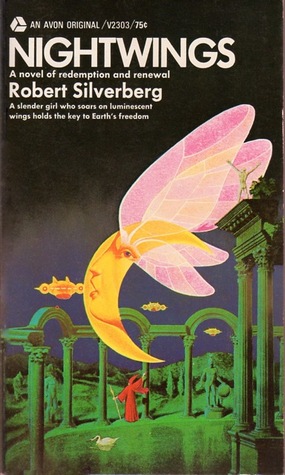
Cover of Nightwings

“To Jorslem” is a sequel to last year’s “Nightwings.” In fact, it’s the second sequel. Having written the first novella Robert Silverberg wrote two more and published them as a novel, also titled Nightwings.[3] In “To Jorslem” we rejoin the Watcher, now calling himself Tomis, as he travels to Jerusalem (Jorslem) as a pilgrim on an occupied Earth.

We’ve skipped the middle novella, where Silverberg put the exposition; Tomis spends most of it researching Earth’s history. In the Second Cycle humanity kidnapped less advanced species and put them in zoos. Meanwhile they started a massive geoengineering project to control the weather. This was a bad idea; it ruined the climate and destroyed North and South America. (Again we have a story where the United States, specifically, is gone.) One of the species whose people were abducted bailed humanity out on the condition that Earth belonged to them whenever they were ready to collect. The invaders’ claim to Earth is legitimate.

I said last time Nightwings feels like a Jack Vance story where not everyone is an asshole. It’s full of weird, impressionistic details. It’s good at creating the impression that these characters don’t share a frame of reference with us while keeping them relatable and human. There’s an incongruous mix of magical technologies and atavistic social structures and a weight of history and science learned and forgotten again.

Jorslem is still a holy city, but these days people believe in “The Will.” “The Will” is a generic force of the type that, if you’re in the mood to be unkind, could be recast as “The Plot.” What it feels like is the force of history. As one character puts it, “The Will does not shape every event great or small; it provides the raw material of events, and allows us to follow such patterns as we desire.” The Will is the choices of others in the past that limit the choices of people in the present, the social context that narrows people’s options—what Silverberg’s Passengers were meant to be, but aren’t.

Ancient technology in Jorslem can restore a pilgrim’s youth, if they’re worthy. Tomis passes the test. His renewal is a full-on psychedelic trip with hallucinated guest appearances from everyone he’s ever met. Speaking of which, in the real world he reconnects with the Flier Alvuela, who tells him she has a new guild he can join, the Redeemers. This is weird; there’s no logical reason for her to be in Jorslem. After declaring her love for Gormon in “Nightwings,” which ended with her symbolically taking off into the sky with him, we’re told they immediately broke up. It’s like once Silverberg decided to expand the original novella he thought Alvuela needed to end up with Tomis for purely structural reasons. Her characterization feels disjointed. But part of the point of the original story was that Tomis didn’t totally understand her in the first place, so maybe that’s not a problem?

The arc of the novel moves towards understanding: from Tomis’ early obliviousness in “Nightwings” to the middle section’s deep dive into human history to the total understanding practiced by the Redeemers. The Redeemers have found a way to enter a telepathic gestalt in which they can feel others’ thoughts and sensations; at the end of “To Jorslem” Tomis mentally flies with Alvuela as Gormon did physically at the end of “Nightwings.” This is another kind of possession, but again it represents a different idea. This is benign, consensual possession—no one in the link loses their identity or individuality, they’re in direct mind-to-mind communication. Basically, radical empathy. The Redeemers are going to “solve” the invasion by accepting that the invaders are here because of the choices of humans who came before, and eventually accepting them into the human gestalt.

In most of these stories, Earth in general and America in particular is hopelessly dead or dying. “To Jorslem” is the one story to suggest building back up from the rubble. Our options may be limited by choices made by people who came before us, but we have enough free will to choose the best of the ones remaining to us.


I’m going to be continuing this series and I’ve started working on 1971, but there might be one or more unrelated posts in between, as I’m currently weary of overwhelmingly male-dominated shortlists. The next installment will probably come within the next month.


  1. As in Star Trek, the people of the Central Worlds just happen to enjoy drama in the public domain as of the mid–20th century. Funny how that works out!  ↩

  2. It’s not clear whether this is a reference, but a ship called the Empire Windrush was one of the first ships to bring Carribean immigrants to the United Kingdom; people who came to the U.K. from those countries after World War II are often called the “Windrush Generation.”  ↩

  3. In the novel this story is called “The Road to Jorslem.” The editor changed it because it sounded like a Bob Hope movie.  ↩
The Venn Diagram of Science Fiction and Fantasy Awards: 1970, Part One

(I’ve been reading the stories that got both Hugo and Nebula nominations. To see all the posts in the series, check the “Joint SFF Nominations” tag.

Because this one was running long, I decided to split it into two parts.)

As the sixties grind to a halt, I’ve noticed SFF take a pessimistic turn. That’s not changing in this installment. The question I try to ask about each batch of stories is what recurring themes do I see? This year I’m noticing two: the first is possession. People are changing bodies or losing their free will. The second is decay. Teenage barbarians roam a nuclear wasteland. A galactic empire collapses as aliens attack the human mind. People on a spaceship forget the outside universe. A fantasy world loses its magic. Earth, long past its prime, succumbs to an alien invasion. In at least two stories, America is just gone. Everything’s falling apart in:

1970

The novels nominated for both the Hugo and Nebula in 1970 were Ursula K. Le Guin’s The Left Hand of Darkness, Norman Spinrad’s Bug Jack Barron, Kurt Vonnegut’s Slaughterhouse-Five, and Robert Silverberg’s Up the Line. The Left Hand of Darkness won both the Hugo and the Nebula, deservedly; it’s a classic, as is Slaughterhouse-Five. I haven’t read the other two.

The stories nominated for both awards were:

  • Gregory Benford, “Deeper Than the Darkness”: A space crew rescuing the survivors of an alien attack discovers the aliens might have a more subtle weapon than they’d assumed.
  • Samuel R. Delany, “Time Considered as a Helix of Semi-Precious Stones” (Won the Nebula for Best Novelette and the Hugo for Best Short Story): A thief visits Earth to sell some stolen goods.
  • Harlan Ellison, “A Boy and His Dog” (Won the Nebula for Best Novella): A feral teenager and his smarter dog scrape by in a post-apocalyptic wasteland.
  • Fritz Leiber, “Ship of Shadows” (Won the Hugo for Best Novella): A nearsighted man living on a spaceship meets a talking cat, acquires a pair of glasses, and runs afoul of vampires.
  • Anne McCaffrey, “Dramatic Mission”: A sentient spaceship ferries a troupe of actors to an alien planet.
  • Larry Niven, “Not Long Before the End”: A warlock confronts the sex pest barbarian who’s been hassling his wife and reveals an appalling secret.
  • Robert Silverberg, “Passengers” (Won the Nebula for Best Short Story): The challenges of dating in a world where people are routinely possessed by incorporeal alien pranksters.
  • Robert Silverberg, “To Jorslem”: The guy from 1969’s “Nightwings” travels to Jerusalem as a pilgrim, hoping to recover his youth.

Which is the best story in this batch? Take a wild guess.

Yep, it’s Samuel R. Delany again, with “Time Considered as a Helix of Semi-Precious Stones.” It’s not the only good story here—I also recommend “Deeper Than the Darkness,” “Ship of Shadows,” and “To Jorslem.” But as usual Delany is working at another level of density and complexity. It’s also a thematic outlier. Most of these stories are preoccupied with a couple of themes. Most absorbed a downbeat flavor from the violent, volatile years when they were written; if civilization hasn’t fallen apart, it’s having a hard time holding itself together. “Time Considered” is less pessimistic, more philosophical, and feels less of its time. It could be published as new today.

The narrator is a professional thief and master of disguise. He changes identities like clothes, keeping only the initials H.C.E. (In other stories from 1970 we’ll see people change bodies, or find their minds changed for them.) H.C.E. begins by telling us his age, but not straightforwardly: “Lay ordinate and abscissa on the century. Now cut me a quadrant. Third quadrant if you please. I was born in ’fifty. Here it’s ’seventy-five.” He’s describing his life as a segment of his century, connecting himself to his context.

H.C.E. returns to Earth to unload his loot. He’s warned off by Maud, who knows an underworld password: the name of a semiprecious stone that can mean different things depending on how and when it’s spoken. She’s a surprisingly friendly envoy from “Special Services,” who predict the movements of criminals. She explains Special Services practices “hologramic information storage,” analogous to the way any fragment of a hologram contains the entire image. Special Services estimates where H.C.E. will be by taking every piece of information they have about him and relating it to his entire life and circumstances. Maud is letting him know because “Information is only meaningful when shared.”

Later, at a party, H.C.E. hears “if everything, everything were known, statistical estimates would be unnecessary. The science of probability gives mathematical expression to our ignorance, not to our wisdom.” The speaker is a Singer. Singers closely observe the world and describe it in extemporaneous poetry and song. It’s illegal to reproduce the Singers’ words; you experience a Singer’s work once, in person.

In his 1964 book Understanding Media Marshall McLuhan argued a medium’s content was less important than the properties of the medium itself: how people relate to different media, what kinds of thought they encourage. In “Time Considered” the Singer tradition developed because “While Tri-D and radio and newstapes disperse information all over the worlds, they also spread a sense of alienation from first-hand experience.” The Singers counterbalance mass media; the point is their immediacy. They relate information back to the world, turning raw data into meaning.

One common fan mode of reading, especially among fans of big franchises like Star Wars and Marvel, is data collection. Fans amass wikiloads of trivia describing every corner of a fictional universe, hunt down backstories for every extra who crosses the screen. They look for continuity errors and “plot holes” and write stories to “fix” them. They want to know everything but don’t think about what it means. What “Time Considered” is doing—

Well, one thing it’s doing, because like all good fiction “Time Considered” is complex and not reducible to a single theme, and I’m not trying to know everything, just looking at one piece of the hologram—

“Time Considered” is arguing for a different kind of reading where lists of facts aren’t ends in themselves but part of a pattern of meaning. By the end of the story H.C.E. can predict how his relationship with a criminal rival will develop, seeing not only the immediate conflict but past it into a future partnership. He’s learning to read information holographically.

“Time Considered” is an outlier among 1970’s nominees because, like the other Delany stories I’ve covered, it shows affection for people. Every character is allowed dignity and a point of view; Delany seems to genuinely like each one. His work feels benevolent. In a Delany story things don’t go right for everyone—that’s the nature of stories—but the worlds he creates aren’t hopeless.

This won’t be true for most of the other stories.

Another Story it’s Not True For

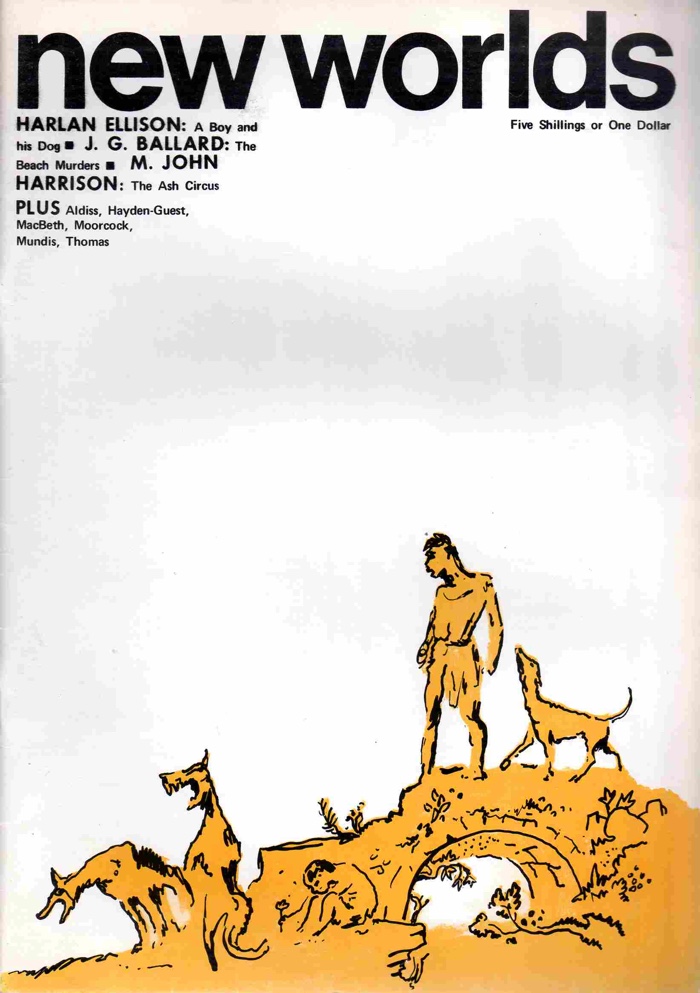
Cover of the issue of New Worlds containing A Boy and His Dog

To maximize the whiplash, let’s consider “A Boy and His Dog.” If you’ve read other posts in this series you’ll have gathered that I find Harlan Ellison ridiculous—he’s the kind of guy a teenager thinks is cool but an adult recognizes as a buffoon—but still love his writing… usually. I’m not a fan of “A Boy and His Dog.” This is the first time I’ve ever made it all the way through this story (though I did know the twist ending).

The reason I hate “A Boy and His Dog” may not be the reason you’d assume. Many SFF fans have strict moral standards for protagonists. The idea is that the main character is there for the reader to identify with, an example to aspire to. If a protagonist does a thing the author must think it’s a good thing to do. This is, of course, completely wrong. A protagonist is not necessarily there for the reader to project themselves onto. A fictional character is a rhetorical device, part of the argument or exploration of ideas that is the story. Sometimes what that argument needs is an asshole. A protagonist doesn’t have to be good, only interesting.

So I don’t have a problem with awful protagonists, which is good because Vic is awful. Blood, his dog, is also awful. All the other characters we meet are awful as well. They live in a post-apocalyptic America that is, you guessed it, awful, except for the underground bunker Vic encounters which is awful in a different way. The problem is that none of this awfulness adds up to anything interesting, or original, or even coherent.

It’s a well-known story that’s had comic book and movie adaptations so you may know the plot. Teenage Vic wanders the wastelands of post-war America with his dog Blood. Blood is intelligent and telepathic, bred by the military; at one point Vic watches a film in which dogs napalm a village. Blood raised Vic and taught him to read. This arrangement seems common. Other boys have other dogs and, like Vic, they were raised to be the kind of people who would napalm a village.

So Vic comes across a young woman, Quilla June. This is the point where I bailed on the story way back when I first tried to read it, because Vic plans to rape her. Because, yes, 1970 has two more stories featuring horrible sex. (At least this batch of stories doesn’t have any incest, which is not a sentence I thought I would need to write before I started this project, but here we are.) Quilla June whacks Vic over the head and leaves, but not before dropping enough clues to let him follow her into her underground bunker. The bunker is set up like a Mayberryesque small town. All the men are sterile and Quilla June lured Vic down to be a sperm donor. On further reflection she’s bored with the whole deal, so she shoots some people and the pair make their way back up. Blood, who stayed on the surface, is injured and needs something to eat, like, right now. A boy loves his dog, so…

“A Boy and His Dog” is comprehensive in its disgust for humanity. The young people on the surface are barbarians, the old people underground are fascists. This story argues civilization is a paper-thin veneer; every American is one disaster away from unleashing the monster just under their skin. Which, fair enough, might have seemed plausible under Richard Nixon, but it’s too much. In the last years of his life, Ellison said in an interview:

“I used history as my model for the condition of the country in ‘A Boy And His Dog,’ where, after a decimating war, like the Wars Of The Roses, for instance, the things that become most valuable are weapons, food, and women. Women were traded and treated like chattel. I tried to make it clear in the stories and the novel that I found this distasteful, but it’s the reality of what humanity’s like when it’s gone through this kind of apocalyptic inconvenience, if you will.”

The Wars of the Roses were also the model for A Game of Thrones, prototype of modern grimdark fantasy. “A Boy and His Dog” has a similar appeal. If you expect the worst from other people that must mean you’re not as bad, right? And it makes you feel smart: you’re seeing the world as it really is, man.

Is it, though? Most apocalyptic fiction assumes after the bomb drops we’ll have to fight off gangs of punk-style barbarians (these days they’re usually zombies). But in real-world disasters people are as likely to pull together as take potshots at their neighbors. Why did this world go for the latter option over the former? “A Boy and His Dog” doesn’t seem to realize the question needs an answer. It’s just assumed that the world after the bomb drops is a world without compassion.

Quilla June is the only important character in the story after Vic and Blood. Even granted that we’re seeing her through Vic’s eyes, he doesn’t understand her, and she spends much of the story manipulating him, she’s weirdly erratic. One moment she vomits because Vic bopped her father on the head, the next she’s gleefully mowing down her neighbors with a rifle. She spends the first half of the story playing Vic like a penny whistle, but at the end suddenly has no idea how to handle him. That the story’s third most important character is a randomly bouncing plot device gives you some idea of how much thought Ellison put into working out anybody’s psychology here. Ellison is angry, and at his best his anger can be incisive, cutting. In “A Boy and His Dog,” it’s just mindless.

(To be continued in Part 2, with more decay and stories of possession.)

The Venn Diagram of Science Fiction and Fantasy Awards: 1969

(I’ve been reading the stories that got both Hugo and Nebula nominations. To see all the posts in the series, check the “Joint SFF Nominations” tag.)

I’m noticing a pattern. I loved the stories I read for 1966. I thought the stories of 1967 were lousy. I had criticisms of 1968, but at least half the stories were good. So is it time for a swing back in the other direction? Alas, yes. Get ready to feel weird and uncomfortable reading the science fiction of:

1969

(…or 1968, depending on how you look at it. As always, stories nominated in 1969 were published the year before.)

The novels that got both Hugo and Nebula nominations in 1969 were Rite of Passage by Alexi Panshin (the Nebula winner), Stand on Zanzibar by John Brunner (the Hugo winner), and Past Master by R. A. Lafferty. I’ve never read Rite of Passage but Stand on Zanzibar is a classic and Past Master is a gloriously weird, underrated novel reprinted in the Library of America’s recent sixties SF set. That set also includes Samuel R. Delany’s Nova, which got a Hugo nomination, and Joanna Russ’ Picnic on Paradise, a Nebula nominee. 1968 was a good year for novels.

It was not such a good year for short fiction, at least judging from the double nominated stories:

  • Brian W. Aldiss, “Total Environment”: Harebrained United Nations scientists build a giant tower block in India and lock hundreds of people inside for 25 years because, as everyone knows, people locked in a crowded building for multiple generations will inevitably evolve ESP.
  • Poul Anderson, “The Sharing of Flesh” (Won the Hugo for Best Novelette): Space anthropologists visit a lost human colony. Their security officer seeks revenge when a native kills and eats her husband.
  • Terry Carr, “The Dance of the Changer and the Three”: A negotiator back from a world of incomprehensible aliens translates one of their folk tales.
  • Samuel R. Delany, “Lines of Power” (a.k.a. “We, in Some Strange Power’s Employ, Move on a Rigorous Line”): A utility crew tries to deliver electricity to one of the last unpowered places in North America. The locals aren’t enthused.
  • Damon Knight, “Masks”: A man whose brain was installed in an artificial body finds it’s having a bigger effect on his psychology than anticipated.
  • Anne McCaffrey, “Dragonrider” (Won the Nebula for Best Novella): The dragon riding people from last year’s “Weyr Search” are back. They fly around and argue a lot. Also, I guess they can time travel now?
  • Dean McLaughlin, “Hawk Among the Sparrows”: An American pilot in a modern fighter jet time travels back to World War I, without even using a dragon.
  • Robert Silverberg, “Nightwings” (Won the Hugo for Best Novella): In the far, far future, a man who’s spent his life watching for a long-prophesied alien invasion visits Rome.
  • Richard Wilson, “Mother to the World” (Won the Nebula for Best Novelette): Everyone dies except one man and one woman, and everything just gets creepy and weird.

This is not as bad a slate as we had for 1967. There are high points. (I recommend “Lines of Power,” “Nightwings,” and “The Dance of the Changer and the Three.”) But brace yourselves, because the lows get super low.

Hawks

We may as well start anywhere, so we may as well start with “Hawk Among the Sparrows.” This is the lackluster tale of an American Air Force pilot who accidentally flies back to the First World War in his modern fighter jet. He’s weirdly blasé; it’s like he’s wandered into a Subway when he meant to go to Burger King. The pilot works out clever ways to leverage his jet against the Germans without modern fuel or weapons. As the story ends he expects the war will be over in a month. The prose is perfunctory, the plot predictable, the story as a whole as boring as it could possibly be, but I think I know why it appealed to a certain audience.

Analog published “Hawk Among the Sparrows” in 1968. By this point if not everyone accepted the Vietnam War was unwinnable they at least knew it wasn’t ending anytime soon. North Vietnam was fighting the greatest military in the world to a stalemate, and that was not how it was supposed to work, dammit. “Hawk Among the Sparrows” is a hawk’s fantasy of how the war should have happened, with an under-equipped enemy falling in record time. America would spend the next few decades looking for an easy war to soothe its bruised ego.

I said last time the nominated stories didn’t engage with the war, but by this point SFF feels less comfortable with colonialist violence. “Nightwings” shows an invasion from the invaded people’s perspective. In “Total Environment” high-handed scientists experiment on nonwhite people. In “The Dance of the Changer and the Three,” “Lines of Power,” and “The Sharing of Flesh” well-meaning people go into other cultures to trade with or “help” them and get in trouble when they won’t (or can’t) meet the locals on their own terms.

“The Sharing of Flesh” is an interesting case. Poul Anderson is a right-winger—you’ll recall he organized the pro-war petition in 1968. He believes in the Spaceman’s Burden: his crew has the ability and responsibility to help the benighted natives of Lokon. But even here there’s an unintentional ambivalence.

One strain of SFF is about contriving justifications for inhumanity. You must perform some cruelty, not because you’re evil but because, sadly, arbitrary and extremely unlikely circumstances have left you no choice. Like, normally smashing baby ducks with a crowbar is terrible, but what if these baby ducks were werewolves? Makes you think! The classic example is “The Cold Equations,” which invents an elaborately ludicrous rationale for its hero to throw a young woman out an airlock. The most popular modern version is the zombie apocalypse story, invariably an excuse to show its hero blowing the heads off an unreasoning mob with a shotgun.

“The Sharing of Flesh” is how this story looks from the wrong end. Evalyth is on an anthropological/humanitarian mission to the planet Lokon, where a guy named Moru kills her husband and makes off with his giblets. Investigating, she discovers a fact the expedition somehow managed to overlook: everyone on Lokon eats human organs as part of their coming-of-age ritual. (You know, one of those minor details.) Investigating further, she discovers the Lokonese have mutated and need hormones from those organs to mature. Moru fed Evalyth’s husband to his kids not because he’s an asshole but because, sadly, evolution has left him no choice. She gives up on revenge. It’s all very Dangerous Visions, except that book’s cannibal story (Sonya Dorman’s “Go, Go, Go, Said the Bird”) was actually good.

Anderson has, probably without realizing it, written his heroes as overconfident and clueless. If they failed to notice the ritual cannibalism practiced everywhere on Lokon—and I’d note they’re so incurious about the local practice of slavery they haven’t noticed the slaves are being eaten—how seriously are they taking the people they claim to want to help?

Power

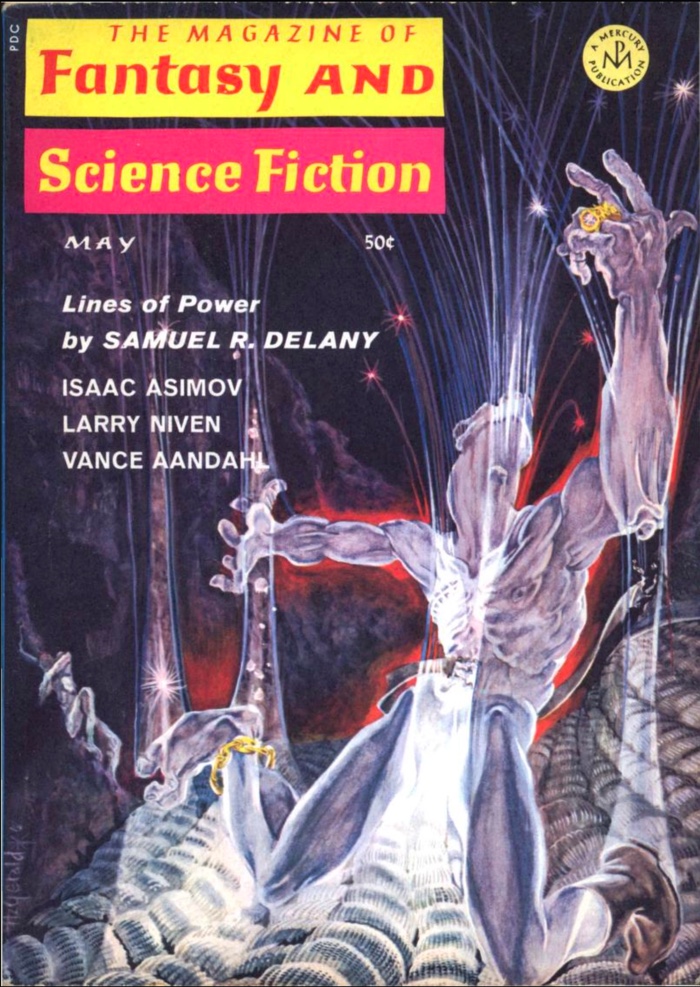
Cover of the Magazine of Fantasy and Science Fiction containing Lines of Power

The best story in this year’s batch is, again, by Samuel R. Delany: “We, in Some Strange Power’s Employ, Move on a Rigorous Line,” which The Magazine of Fantasy and Science Fiction published as “Lines of Power” because they were cowards. This is a story about power, and power—electrical power and political power. The first image is the memory of an accidental electrocution. You have to be careful with power. You lose control, you get zapped.

What’s fascinating and baffling about SFF awards is the gap—heck, the yawning chasm—in quality between stories on the same shortlists. Many are the work of writers who think a story is just a description of things happening, with a pat moral or simple metaphor to add spice. And then you have the real writers, like Delany, whose fiction has depth. “Lines of Power” explores a thematic space and creates resonance by iterating through different definitions of power and evolving its imagery throughout the story.

In the future, the entire world has been hooked up to a high-tech electric grid providing too-cheap-to-meter power. The narrator, who goes by the nickname “Blacky,”[1] works on a mobile cable-laying machine the size of an office building. He’s just been promoted to “section-devil”—the line workers are “devils” and “demons”—and is learning the ropes from his fellow section-devil and former boss, Mabel.

The law says anywhere people are living has to be hooked up to the grid. The Global Power Commission found people living in a place that isn’t. This is High Haven, an estate on the Canadian border. The residents aren’t interested in going online. This is not (as would be most writers’ first thought) because they’re a low-tech community like the Amish. The Havenites are a biker gang descended from the Hell’s Angels. For the Angels to accept this devilish temptation would mean admitting the GPC has power over them.

Blacky negotiates with Roger, the head of the community. The last boss was a violent bully and Roger got the position by beating him up and driving him away. Roger can’t let Blacky win the argument because he can’t show weakness. To back down is to abdicate. Power based on strength is brittle. And, wielded without care or subtlety, it’s liable to turn on the user the way Roger turned it back on his predecessor. When Blacky tells us Mabel doesn’t like to waste power, it could mean more than one thing.

As for the rights and wrongs of unilaterally barging in to hook up High Haven, the story doesn’t come to any conclusions. Blacky wants to leave the Angels alone. Mabel is determined to install the lines because that’s what the law requires. When the Angels flee she stands down: with no one living at High Haven, it legally doesn’t have to be on the grid. Power needs conduits, constraints. Mabel keeps her power in check by sticking to the rulebook.

Getting or Not Getting It

Richard Nixon wouldn’t use the phrase “silent majority” until late in 1969, but as Rick Perlstein documents in his book Nixonland he had for some time sold his political career on dividing ordinary Americans from an imagined un-American liberal elite. Perlstein argues the late sixties were the origin of the United States’ current irreconcilable political cultures, incompatible not only in values but in epistemologies. The Vietnam war dragged on; the now-regular protests made no difference, and neither the doves or the hawks were changing anyone’s minds. Politics were getting violent. During the summer of 1967 a wave of antiracist protests across the United States escalated into riots when the police showed up, and in 1968 there were more riots at the Democratic Convention in Chicago. Meanwhile in the Hugos and Nebulas, our other big themes for 1969 are failures of understanding and irreconcilable differences. It feels like SFF is losing faith in people’s ability to understand each other.

Poul Anderson’s anthropologists miss basic facts about the Lokonese. The hero of “Total Environment” fears the people in the tower block and everyone outside are growing mutually incomprehensible. This is where “The Dance of the Changer and the Three” comes in. It’s good, and feels like Stanislaw Lem’s work. It is, first, a science-fictional folktale, a form Lem worked with in Mortal Engines and The Cyberiad. It also features really alien aliens. Like the planet Solaris and the aliens in Lem’s Eden and Fiasco, these are aliens we not only don’t, but can’t, understand.

The Loarra are energy beings. Every so often they “die” and re-coalesce as a new person. They’ve let a human expedition settle in to mine rare elements. (The Loarra are incorporeal, so I guess they’re not using them.) The narrator is the expedition’s public relations guy. He tells one of the Loarra’s oldest folktales, about three Loarra who create a new life form only to absorb it again. Then he tells us about the day the Loarra killed the miners, and afterward were as friendly as though nothing had happened, and couldn’t explain why. The reason was untranslatable.

Although there’s something just as alien closer to home. The survivors return to Earth and describe the situation to “Unicentral,” their computerized corporate overlord. They ask whether they should go back to Loarr. Unicentral can’t make up its mind. On the one hand there’s the risk to human lives. On the other, there’s money to be made. Like, a lot of money. The value of one is evenly balanced against the other. It’s possible the Loarra don’t understand what it means for humans to die. Unicentral doesn’t care.

Damon Knight’s “Masks” is about irreconcilable differences between human and machine. Jim is the first person to have his brain installed in an artificial body. His doctors worry he’s not adjusting—is he dreaming all right? Does he want a more expressive face? No, Jim’s problem is that, separated from his body, he’s lost every emotion but one. He’s grossed out. Organic life is leaky and squishy, and he can’t coexist with it. Knight’s writing is great, the ending has the force of a punch,[2] but “Masks” is thematically slight. There’s not much to it beyond Jim’s dissociation from humanity. It’s a familiar theme—not far off what Doctor Who had already done with the Cybermen. If you want more detail, Knight gives a close reading of his own story in the third edition of his book In Search of Wonder.

I said last time I wasn’t a fan of Robert Silverberg; I normally find his work fine but forgettable. But “Nightwings” is great—It feels colorful, like a Jack Vance story where not everyone is an asshole, and has real complexity. It’s about the gap between perception and reality, how we misunderstand what we see when we see it through our preconceptions. It’s thousands of years in the future and the narrator is a Watcher, a member of a guild watching the heavens for a long-anticipated alien invasion. He’s come to Rome (or “Roum”) for no particular reason. He suspects the invasion will never happen, that he’s wasted his life. The first time he sees the ships he dismisses them. They have to be his imagination.

The Watcher’s companions aren’t what they seem. He thinks the odd-looking Gormon is a human mutant, guildless and low-status in the eyes of society, though the Watcher respects him. But Gormon is something else entirely, and someone more powerful. Avluela is a Flier, a slight, winged human, and the Watcher thinks of her as a daughter. He describes her like she’s one of those old-fashioned science fictional ingénues who spend the whole story getting infantilized. But look past the Watcher’s narration and she’s making more of her own decisions than he realizes. (For one thing, he’s completely missed that she and Gormon are sleeping together.)

Avluela’s often the first person to ask important questions. When Gormon rattles off ancient Roman history she’s the one to ask “How are these things known?” Earth has forgotten its history. The guild of Rememberers have reconstructed parts, but there are still artifacts and ruins people see without understanding. When the aliens arrive the Watcher’s guild dissolves; their task is complete and there’s nothing left to Watch for. The Watcher leaves Rome intending to join the Rememberers. Depending on how you want to read the story, this could mean Earth no longer has a future to watch for. Or it may mean the Watcher can still learn to understand.

What the Hell, SFF?

I said 1968 was not a good year for short fiction. Here’s where I explain why. Only three stories are worse than “Hawk Among the Sparrows,” but they really bring the average down.

Anne McCaffrey’s “Dragonrider” is the sequel to last year’s “Weyr Search.” It picks up some time after the last story. I get the impression the events between might be included in the novel version. From what I gather F’Lar and Lessa’s dragons mated, and sort of mind-controlled F’Lar and Lessa into also mating, and now they’re dragon-shotgun-married and sleeping together even though they hate each other? F’Lar is constantly shaking Lessa, like Homer Simpson is always strangling Bart. Incredibly, this is not the creepiest sexual relationship we’ll see in this batch of stories.

Anyway, F’Lar and Lessa spend “Dragonrider” bickering and solving problems the dragon riders really should have figured out ages ago, like how to hold a dragon-bonding ceremony without the newly hatched dragons inadvertently eviscerating half the candidates. Lessa accidentally discovers dragons can time travel, which I guess the dragons had forgotten to mention. This is lucky, because the dragon riders are understaffed and now they can get more dragons from the good old days when dragon riding was cool. Like “Hawk Among the Sparrows,” this story thinks life would be better if we could go backwards. Also, McCaffrey’s prose has not gotten less clunky. Somehow this won a Nebula over the Delany, and I have questions.

Before starting this reading project the only Brian Aldiss I’d read was Billion Year Spree, his history of science fiction. Two stories in, I look upon his work with weary dread. “Total Environment” is a story about India written by a white British guy in the sixties. I’ll say this for it: it’s not as racist as “The Eskimo Invasion.” This is not the same thing as not racist.

25 years ago United Nations scientists sealed 1,500 Indians into a giant tower block called the Total Environment. (All volunteers; there was a famine at the time and the UN shovels in enough food for everyone.) In that time four generations have been born and the population has ballooned to 75,000. This is meant to encourage psychic powers. “High-density populations with reasonable nutritional standards develop particular nervous instabilities which may be akin to ESP spectra,” explains an alleged scientist.

As the Total Environment got more crowded it went all Lord of the Flies. Life spans dropped; people are middle aged at 20. Criminal bosses run each floor and fight wars with each other. People are kidnapped into slavery. There’s a lot of talk about rape and mentions of incest. No one tries to escape and no one even thinks about the outside world. “Hinduism had been put to the test here and had shown its terrifying strengths and weaknesses,” we’re told. “In these mazes, people had not broken under deadly conditions—nor had they thought to break away from their destiny. Dharma—duty—had been stronger than humanity.” It’s because they’re foreign, don’t ya know.

Aldiss’ hero, Thomas Dixit, is Anglo-Indian. The story defines his character by the Anglo part. He’s afraid four generations of separation are turning the Environment’s inhabitants alien. On the surface, “Total Environment” implies anybody dumped into the Total Environment would evolve into psychic weirdos. Everyone instinctively looks for new horizons. If they’re prevented from looking outward they’ll look inward, into the very small and into their own minds. But the details are racially coded and their powers are depicted with a hefty dose of orientalism. The power we get to see is the ability to kill remotely, and the story tells us “It had long been known that African witch doctors possessed similar talents, to lay a spell on a man and kill him at a distance; but how they did it had never been established; nor, indeed, had the fact ever been properly assimilated by the west, eager though the west was for new methods of killing.”

When Dixit visits the Total Environment, the inhabitants plead to be left alone like they’re pleading with a colonizer: “Tell them to go away and leave us and let us make our own world. Forget us! That is my message! Take it! Deliver it with all the strength you have! This is our world—not yours!” Dixit argues for ending the project, whatever they think. And he may be right—the Total Environment is not indefinitely sustainable. But like Rudyard Kipling, who uses the phrase “Half devil and half child” in “The White Man’s Burden,” Dixit doesn’t think of these people as adults. Speaking of a local boss who sees advantages in allying with the outside world, Dixit says “He exhibited facets of his culture to me to ascertain my reactions—testing for approval or disapproval, I’d guess, like a child.” Like “The Sharing of Flesh,” “Total Environment” has twinges of unease but comes down in favor of paternalism—as long as it’s of the right sort.

Finally we come to the story that won the Nebula for Best Novelette, Richard Wilson’s “Mother to the World.”

Oh dear.

Some stories are unjustly forgotten. “Mother to the World” is forgotten because everyone is politely not talking about it. I don’t often use the primarily moral approach to criticism, where you decide a book’s value by tallying up how it is or is not problematic. It’s usually not the most interesting or enlightening lens through which to view a story. But sometimes a story’s values are the only reasonable place to begin, and here’s one of those cases. “Mother to the World” is deranged.

It’s an Adam and Eve story. The entire human race has died and one man and one woman are left. See, what happened was China released a biological weapon that reduces human beings to powder, and… uh, the wind blew it back in their faces. (Really.) Anyway, there are no corpses to deal with. Martin Rolfe, an editor, and Siss, a housekeeper, survived because they were staying at a NASA scientist’s house. The only unused rooms were environmentally sealed rooms with their own air supplies. And… the people dissolver spread all over the world in a few hours, then went inert, I guess? None of this bears thinking about, but at least it doesn’t bear thinking about because it’s silly and not because it’s offensive. This can’t be said for the rest of the story.

Remember the Cold Equations stories? The ones that contrive farfetched situations forcing the protagonist to do something awful that is somehow not their fault? Adam and Eve stories are almost always Cold Equations stories. It’s generally a dude asking “What if a woman was, like, morally obligated to sleep with me?” “Mother to the World” is one of these. Richard Wilson’s unique twist is that Siss is mentally handicapped and has “the mentality of an eight-year-old.”

At this point you’re probably asking “does he really go there?” The answer is yes. Yes, he does. Which raises all kinds of questions about consent and relative power, which the story doesn’t attempt to answer because it didn’t notice it raised them.

When I read fiction my standard policy is to assume the writer means well. If I try very hard I can sort of guess what Wilson was going for here. Early in the story Rolfe tells himself he’s more valuable than Siss because “he was smarter than she was and therefore more worth saving.” And I think Wilson’s intent was that Rolfe learns Siss’ value as a human being does not depend on her IQ, and Siss teaches Rolfe the meaning of love. (The story ends with their son asking “Is this what love is?”) If so, it doesn’t work.

This story can’t get past the fact that its central relationship is wildly, creepily imbalanced. To be fair, Siss often comes off less like a person with literally “the mentality of an eight-year-old” and more like a naïve and poorly educated but still functional adult. But she has a go-along-to-get-along personality and at no point is she an equal partner in this relationship, which slips creepily from guardian-and-ward to marriage. The story contrives to give Rolfe a relationship in which he’s completely dominant and gets to make all the decisions.

On the prose level “Mother to the World” is actually well written. There are vivid images and observations: “Several times he found a car which had been run up upon from behind by another. It was as if, knowing they would never again be manufactured, they were trying copulation.” The story has its own voice distinct from its characters; it’s able to switch registers when it quotes Rolfe’s journals. In places the prose rises to the lyrical, and the story manages to feel intermittently mythic without being at all overblown.

But this story’s values are alien. It kept tripping me up with its weird assumptions. Like, at one point Rolfe is planning how to keep his proposed family clothed (which doesn’t seem like a problem given the vast stocks of clothing that won’t be wearing out anytime soon). He jumps to the conclusion that “Nudity might be more practical, as well as healthier.” Um, okay, dude, you do you. And there’s the moment Rolfe tells his son if he ever has to choose between saving his father or his mother he should save his mother, because…

At this point you are probably again asking “does he really go there?” And, people, I have learned two things about Richard Wilson:

  1. In his day job, he was director of the news bureau for Syracuse University.
  2. “There” is a place he was always willing to go.

“Mother to the World” is rarely reprinted, for reasons I hope are obvious. [3] I’ve rarely read a story so oblivious to how uncomfortably weird it is. It feels like Richard Wilson thought he’d written an uplifting parable about love and valuing other human beings, and was blissfully unaware it was a total creepfest.

The danger of writing characters who fail to comprehend each other is that their writers may fail to comprehend them themselves. Brian Aldiss thinks of the Indian inhabitants of the Total Environment as alien, like the Loarra. He writes according to his surface preconceptions about how an “Indian” society should look, with holy men and universal fatalism (nobody is interested in the outside?) instead of rendering them in their full complexity. Richard Wilson wants to understand Siss but fails, so fails to realize her relationship raises thorny questions of power and consent. Aldiss and Wilson haven’t thought through these characters or gotten into their heads. They’re not supporting characters, they’re props.

At least it didn’t take many votes to put “Mother to the World” in first place. I was looking for references to the story on Google Books and found an excerpt from The Business of Science Fiction by Mike Resnick and Barry Malzberg. Malzberg was nominated for “Final War” (as K. M. O’Donnell) that year. He explains the Science Fiction Writers of America was a small organization in the 1960s and the Nebulas used a first-past-the-post voting system, so it took very few votes to win. “Mother to the World” took the trophy with 19 votes. So only 19 people thought the creepy Adam and Eve story was the best Novelette of the year.

But, honestly, that’s 19 too many. And it was nominated for both awards, as was “Total Environment.” And I wonder: are SFF shortlists any better now, or is 21st century SFF just strange in ways that aren’t obvious to us? Which of today’s Hugo and Nebula nominees will make tomorrow’s readers feel weird and uncomfortable?


  1. The line workers get along great. The one odd note is that they keep reminding Blacky he’s Black, even giving him, y’know, that nickname. Maybe Delany thought the readers wouldn’t notice Blacky was Black unless he really hit them over the heads with it.  ↩

  2. If you need to know whether the dog dies, this is not the story for you.  ↩

  3. To get hold of it I bought a used copy of Nebula Award Stories 4, which includes a few other rarely-reprinted stories so wasn’t a bad deal.  ↩