Monthly Archives: July 2010

Links to Things

I haven’t done many of these links posts lately, so I have a bunch of links saved up. I’ll try to get caught up over the next few weeks.

  • First, Aaron Diaz of Dresden Codak has started a new blog on which he writes perceptively about the craft of comics. It’s very new, but he’s already written several posts that have clarified things I’ve been doing haphazardly and inconsistently because I hadn’t thought about them consciously. Example: body language. Sometimes I manage to express my characters’ personalities through my drawings—through Bob’s frequently hunched-over posture, or Buck’s disregard for other people’s personal space—but sometimes they’re more or less talking heads.

    Also useful: Comic Tools has been on hiatus for a while, but there’s lots of helpful stuff in the archives. New Construction is Kevin Huizenga’s new blog about “cartooning practices and concerns.” And Temple of the Seven Golden Camels is written from the point of view of an animator, but has lots of good advice about draftsmanship and composition.

  • Laura Miller, at Salon, writes about the brave new world, anticipated by many aspiring authors, in which anybody can get their books “published” without going through the filter of an actual publisher. Self-publishing enthusiasts like to talk about what this means for writers; Miller focuses on on what this would mean for readers:

    A diamond encased in a mountain of solid granite may be truly valuable, but at a certain point the cost of extracting it exceeds the value of the jewel. With slush, the cost is not only financial (many publishers can no longer afford to assign junior editors to read unsolicited manuscripts) but also — as is less often admitted — emotional and even moral.

    It seriously messes with your head to read slush. Being bombarded with inept prose, shoddy ideas, incoherent grammar, boring plots and insubstantial characters — not to mention ton after metric ton of clichés — for hours on end induces a state of existential despair that’s almost impossible to communicate to anyone who hasn’t been there themselves: Call it slush fatigue.

  • On a related note, have you ever tried to search for something on Amazon.com, and found your search results littered with generic-looking print-on-demand books? If you actually were to order one of those things, this is what you’d get. If Amazon were to scour these things from their catalog they’d be doing their customers a favor… but that’s not likely to happen; as long as there are people unwary enough to buy the things, Amazon will turn a profit from them.

  • Sarah Monette, on why craft trumps inspiration:

    It occurred to me today that one of the places from which the idea that craftsmanship and devotion to craftsmanship are unworthy of artists might be coming is the Renaissance idea of sprezzatura, the art of making the difficult look easy. Sprezzatura is all about disclaiming effort, about presenting the appearance of not working hard to achieve perfection, and it seems to me like there’s a point of slippage between sprezzatura as a pose, equally understood as such by author and audience, and the devaluation of craft.

  • Kit Whitfield on why it’s a mistake to assume too much about a writer’s mental state from their work:

    Well, ask yourself this: if an inept draftsman creates a picture of a man whose head is too small and whose right hand is half the length it should be, does that mean the draftsman actually believes we live in a world full of tiny-headed, bob-handed people? No; all it means is that the draftsman isn’t very good at reproducing the reality he or she sees. And the same attains to writing. Writing is pretty difficult, reality is massively complicated, and even a moderately accurate reproduction of it is hard to manage. Get it wrong, and you’ve created a weird facsimile of reality that sounds, well, crazy.

    And on “metaphorisation”:

    Fiction creates situations where the strong feelings are tied to events dramatic enough to justify them. It’s one of the great escapist satisfactions of reading: not escaping into a more comfortable world, but escaping into a world where you have good, unchallengeable reasons for feeling the way you do.

  • SF blogs in the past year or so have periodically been writing about representations of different cultures, and cultural appropriation. Hal Duncan has written an essay thinking about appropriation, abjection, and related topics. I’m not certain what to excerpt; just go read it, if the subject interests you.
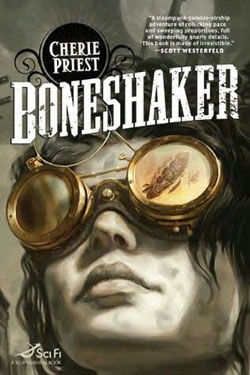
Cherie Priest, Boneshaker

Cover Art

Last year, the SF blogosphere was so excited about Cherie Priest’s Boneshaker you would have thought it had caused actual bones to be shaken. I suspect massive name recognition was a major reason this novel ended up on both the Hugo and Nebula shortlists, because Boneshaker does not aspire or pretend to be anything more than a light, breezy adventure novel–the kind of book that meets the baseline standard of “entertaining” but isn’t meant to step beyond into “exciting” or “compelling.” This is a good and worthwhile thing for a book to be… but it’s not unusual.

From the Nebula or Hugo shortlist, I expect something ambitious, or moving, or thoughtful, or beautiful. Something significant, memorable, and mind-blowing. A book that a reasonably well-read person might honestly judge to be among the five or six best SF novels published in the past year. I am, in other words, in Adam Roberts’s camp on the whole Hugo Awards deal.

Yes, I know. The fact that Cory Doctorow and John Scalzi were nominated for Little Brother and Zoe’s Tale, neither of which rose to Boneshaker’s level of craft–or that Robert J. Sawyer and Jack McDevitt have ever been nominated at all, for anything–should have squashed my illusions. Still, I cannot extinguish the small ember of hope that whispers maybe, this year, the nominators followed some criteria more stringent than “What are people talking about on the internet?”

The problem with this, I’d argue, is not so much that it’s unfair to other, more ambitious SF novels that go unrecognized. They’re big books and can take care of themselves. What’s worse is the vast disservice it does to books like Boneshaker.

A reader’s experience of a book depends partly on the assumptions they bring to it. It’s like James Thurber’s story “The Macbeth Murder Mystery”: Pick up Macbeth thinking it’s a detective story, and you’ll read it wrong. Anyone who reads Moby-Dick like a C. S. Forester novel will be bored and annoyed and will miss all the really good bits, and you can say the same for a reader who comes across the Horatio Hornblower stories while looking for another book like Moby-Dick. Or a reader who reads a light adventure novel expecting an award nominee. I read Boneshaker because it made the Hugo and Nebula shortlists, and was left without much patience for a book I might otherwise have enjoyed. When the Nebula judges saddled Boneshaker with a nomination, they guaranteed that a large chunk of its potential audience would come to it with the wrong expectations.

So, ignoring the nominations… how good is Boneshaker at being what it actually tries to be? Here I have to admit that, with different expectations, I would still have been… not necessarily the wrong reader for this book, but not the ideal reader. I’ll overlook a lot if a book pushes my buttons; I cut Boneshaker less slack because the buttons it pushes belong to other people. One reason Boneshaker got so much attention was that it managed to incorporate two current internet fads: it’s a steampunk novel about a city overrun by zombies. Steampunk I can take or leave. Zombies are boring, and I absolutely cannot wait for SF fans to get over their fascination with the things. The zombies are not Boneshaker’s main focus, so I can’t say they bothered me, but I wasn’t excited to see them, either.

So when I say I thought Boneshaker wasn’t as fast-paced and breezy as I’d like, that it in fact seemed drawn out far too long… well, it’s a relative judgement. One of Kage Baker’s Company novels, Mendoza in Hollywood, is a couple hundred pages of time travelers just sort of hanging out in 19th-century California, followed by a slight trace of plot. I couldn’t put it down. I like spending time with Baker’s characters and her world, even when her characters have so much downtime they spend an entire chapter watching a movie. If you like spending time with zombies and steampunk gadgets, maybe you’ll want as much Boneshaker as you can get.

Me, though… I thought the novel would have been stronger if it had been cut in half. And there’s a specific half that’s disposable. Boneshaker is split between the points of view of Briar Wilkes, the widow of the man whose pulp-villain-style drilling machine loosed a plague of zombies on Seattle, and her son Zeke, who kicks things off by sneaking into the now-walled city to find traces of his dad. Of the two leads, only Briar is interesting.

Zeke’s only function in this story is to be rescued, and his rescue would have been more suspenseful if we’d had no more idea than Briar of what had become of him. Instead, we spend every other chapter watching Zeke bounce from character to character and fail to accomplish anything. Whenever Boneshaker switches to Zeke’s point of view, the story starts running in place. Typical of Zeke’s half of the book is a chapter in which he’s put on a dirigible leaving the city; it turns out to have been stolen, the original owners show up to retrieve it, and Zeke runs away. Neither dirigible crew appears in the novel again, and the incident has absolutely no effect on anything. It’s just a teaser for another novel in the same universe.

Briar is smart and resourceful and drives the plot. Boneshaker is really entirely her story–it’s about getting her life unstuck and into a place where she can talk about her past and move on. The escaping-from-zombies bits might go on a bit too long for my taste, but Briar’s chapters have all the excitement missing from Zeke’s. A sign of the skill and craft behind this book, and the thing that most impressed me, was one of the climactic revelations–without saying too much, one of Boneshaker’s central mysteries is a question of identity; Cherie Priest’s answer seems superficially anticlimactic but is actually far more interesting than the alternative, and it sets up a bigger revelation at the end of the book.

So am I recommending Boneshaker, or not? I guess I’d recommend half of it, to steampunk fans. Fortunately, it’s easy to read just Briar’s half: the chapters are prefaced with engravings of a pair of steampunk goggles or a dirigible, depending on whether they’re Zeke’s chapters or Briar’s–and Zeke’s chapters don’t drive the plot, so the novel is perfectly comprehensible without them!

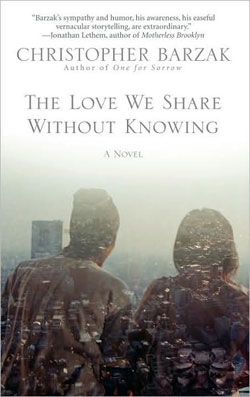
Christopher Barzak, The Love We Share Without Knowing

Cover Art

I’ve been letting my blog slide again. This is mostly due to general tiredness. I get the impression that the periods when I don’t write much are also the periods when I don’t think as deeply or concentrate as well, so I’m trying to restart my brain. I think it could use the exercise.

A while back I read this year’s Nebula nominees. (All but the one that actually won, Paolo Bacigalupi’s The Windup Girl, which, having read Bacigalupi’s short stories, I felt I’d practically already read.) I was going to write something about all of them but I stopped before getting to The Love We Share Without Knowing and Boneshaker. They seemed like a good place to restart these reviews.

I liked Christopher Barzak’s The Love We Share Without Knowing–this was the book I’d hoped would get the Nebula–and yet I’m not sure how much I have to say about it that can’t be distilled to a banal “Hey, this is really good.” Which is why this review is short.

TLWSWK is the kind of novel built from short stories whose characters weave in and out of each others’ lives. The stories are set in the area of an English-language school in Japan staffed partly by young American expatriates who moved abroad to find their lives are pretty much the same wherever they go. There’s no single overarching plot, and most stories could stand on their own, but the whole is greater than the sum of their parts.

The problem with this kind of thing is that some readers might miss the whole if they don’t like the parts. Here, the first story is the weakest; it hinges on a plot twist that anyone who’s read more than a couple of ghost stories will see coming from a thousand miles away, and when it’s over its narrator entirely disappears from the book. If anyone read the first story and put the book down, and is now reading this review, then give it another chance, okay?

The title is taken from an incident that crops up in two stories, told from two perspectives. Two people who’ve checked into a Japanese “love hotel” find a note in the guest book from someone who didn’t come with a partner–someone who just comes for the atmosphere, who feels a connection with the unseen strangers in the other rooms and “the love we share without knowing.” For one of the point-of-view characters in that doubled scene, finding the message is a perspective-changing moment; the other doesn’t get it. Not that it’s likely that everything that goes on in that hotel is love, but Guest Book Guy is at least trying to make connections.

The structure of TLWSWK is also its theme. It’s about what it is–about its characters’ inadvertent assumption of bit parts in other characters’ stories, how they unintentionally, like random pool balls, knock friends and strangers onto new trajectories. In this book’s world, karma isn’t something that comes back to you but something that rubs off on other people. One person’s decision, years later, nudges a friend in the same direction; relationships that don’t mean much to one character change others’ lives; a character is saved by another’s decision to ignore an instruction. It’s slightly scary to think we may never know the best and worst things we’ve done in our lives because the consequences played out years later, or miles away, and maybe among strangers.