Monthly Archives: April 2010

Links to Things

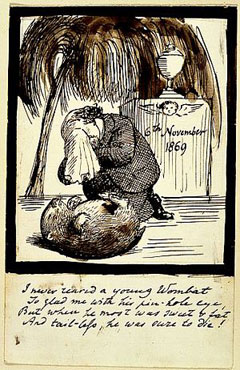
A sad wombat-related moment.

I’ve been unable to write much recently. I’m even behind on the comics. Exhaustion seems to be the problem; I come home in the evenings and can’t focus on anything much.

It’s been a while since I even did one of these links posts… but I do have a few links, so just to keep the blog going, here they are:

  • Apparently the Pre-Raphaelites were really into wombats. I recently read some doggerrel Dante Gabriel Rossetti had written about his wombat, and assumed it was some kind of parody. But no—Rossetti loved wombats. Here, from the website of the National Library of Australia, is a history of Pre-Raphaelite wombats:

    Much later, in 1857, by which time he was a national celebrity, Rossetti was commissioned to decorate the vaulted ceiling, upper walls and windows of the library of the Oxford Union. He mustered a large group of helpers, including his new Oxford undergraduate friends, the future artists Edward Burne-Jones and William Morris, as well as the artists Roddam Spencer Stanhope, Arthur Hughes and John Hungerford Pollen. Recalling the hugely enjoyable experience of working in the Oxford Union, another artist—helper Val Prinsep—recalled: ”˜Rossetti was the planet around which we revolved, we copied his way of speaking. All beautiful women were “stunners” with us. Wombats were the most beautiful of God’s creatures.’

  • Dante Gabriel Rossetti liked wombats; Honoré de Balzac liked coffee. A lot. He described its effects in a delightfully crazy essay called “The Pleasures and Pains of Coffee”:

    Finally, I have discovered a horrible, rather brutal method that I recommend only to men of excessive vigor, men with thick black hair and skin covered with liver spots, men with big square hands and legs shaped like bowling pins. It is a question of using finely pulverized, dense coffee, cold and anhydrous, consumed on an empty stomach. This coffee falls into your stomach, a sack whose velvety interior is lined with tapestries of suckers and papillae. The coffee finds nothing else in the sack, and so it attacks these delicate and voluptuous linings; it acts like a food and demands digestive juices; it wrings and twists the stomach for these juices, appealing as a pythoness appeals to her god; it brutalizes these beautiful stomach linings as a wagon master abuses ponies; the plexus becomes inflamed; sparks shoot all the way up to the brain.

    He also observes:

    Many people claim coffee inspires them, but, as everybody knows, coffee only makes boring people even more boring.

    I think Starbucks should put that on their cups.

    Apparently Balzac died of caffiene poisoning; until I read the introduction to the essay I hadn’t realized that was possible.

  • At The Hooded Utilitarian, Ng Suat Tong reviews one of the saddest comics I’ve ever read: Tony Millionaire’s Sock Monkey Volume 3 Number 2.

  • Finally here’s a review of Farmville, an online game which I had never previously heard of, mostly because I don’t spend any time on Facebook but also because I really am completely out of it. Farmville sounds completely appalling:

    We are obligated to examine what we are doing, whether we are updating our Facebook status or playing Call of Duty, because the results of those actions will ultimately be our burden, for better or for worse. We must learn above all to distinguish between the better and the worse. Citizens must educate themselves in the use of sociable applications, such as Wikipedia, Skype, and Facebook, and learn how they can better use them to forward their best interests. And we must learn to differentiate sociable applications from sociopathic applications: applications that use people’s sociability to control those people, and to satisfy their owners’ needs.

    “Sociopathic application” sounds ridiculously melodramatic, but the author makes a good case for the term.
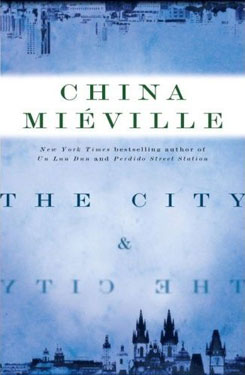
The City and the City

Cover Art

China Miéville’s The City and the City is another Nebula nominee. It’s a police procedural set in two imaginary cities. If you haven’t read it, it might be best to stop reading this review now. The City and the City doesn’t dump its premise on you all at once; odd details pile up, and one or two chapters in the true premise hits you and remaps your entire perception of the story.

On the other hand, if you’ve heard of The City and the City at all, you probably know the concept. Some stories have twists that will never surprise anyone again, because they’re part of our common mental furniture. Everyone who sees Psycho knows not to get too attached to Marion Crane. Among SF fans the premise of The City and the City is already just as well known. So I won’t be spoiling anything for most people when I explain that The City and the City is set in two imaginary cities that occupy the same space.

The citizens of Beszel walk the same streets as the citizens of Ul Quoma. No one remembers how, or why, the cities split, but over the centuries the divergent cultures maintained separate identities with complicated mental defenses. The cities learned to unsee each other. Tyador Borlú, the Beszel police detective at the center of the story, walks among Ul Quomans and is effectively alone. All his life he’s been trained in selective attention. He doesn’t acknowledge that Ul Quoma is there. If he did, he’d be in trouble; no one wants to come to the attention of Breach, the group that polices the imaginary boundary between the two cities.

This sounds like fantasy, and maybe it is… but only just barely. We “unsee” things all the time. Things we don’t want to acknowledge… or people we don’t want to acknowledge. When I Googled The City and the City to check the spelling of names and places, I found a review that mentioned the secret cartography of London gangs:

These political alignments and the ground they contest are unknown to most of the inhabitants of the city, but mean life and death to others. A fascinating but depressing report released by the Joseph Rowntree Foundation last year explored this territoriality. It included maps drawn by teenagers that revealed their neighbourhoods as patchworks of “safe” and “no-go” areas, an exquisitely complex secret topography.

That sounds just like the “crosshatched” maps of Beszel and Ul Quoma.

Unseeing isn’t always a bad thing. The human brain can only process so many things at once; if we consciously acknowledged everything we perceived, all the time, it would be hard to sort out which details were immediately important. You don’t want anyone stopping in the middle of a crosswalk, distracted by the ants and the weeds and the cracks in the asphalt, while a car hurtles towards the intersection! And when you’re traveling home on a crowded bus, politely “unseeing” the other passengers lets everyone read or talk to friends or just unwind in the pretense of privacy.

But sometimes people take selective attention too far. One of the clichés that get thrown around a lot when people talk about the United States is the “melting pot.” This isn’t a great metaphor—it raises images of people rendered down into homogenous goo, being assimilated but not assimilating anything themselves. But it does at least approach something true: put cultures next to each other, and they mix. They trade. They fall in love. Which is scary for the people who’ve built their identities around belonging to the culture on the top of the pyramid. So they build walls, and patrol the deserts. Certain neighborhoods become anathema. Certain people are not “real” citizens. They squint suspiciously at anyone who looks like they don’t belong, and refuse to acknowledge that sometimes the people who “don’t belong” have actually been around longer than they have…

Beszel and Ul Quoma can only maintain their purity as totalitarian states. No one in either city has a choice in what to see or unsee—no one gets to decide what’s important to them. The division between the cities takes precedence over everything, even life and death. If Borlú came upon an Ul Quoman dying on the street, he’d have to unsee and walk away, or face Breach.

This is a problem for a man investigating a murder that crosses between cities. I could predict Borlú would have to choose between catching a killer and throwing away a lifetime of mental training. What surprised me was that Borlú steps outside the barrier between Beszel and Ul Quoma but doesn’t permanently disrupt it. Order is maintained, the status quo continues. I guess I shouldn’t have been surprised—Miéville’s never seemed optimistic about the possibility that things might change for the better. (Iron Council ended with the image of a revolution that perpetually approaches but never arrives.) You can climb over the walls, but you can’t tear them down. Borlú can refuse to look away from the unseen, but once he does he can never return to ordinary life.