Monthly Archives: February 2010

Dino Buzzati, Poem Strip

Cover Art

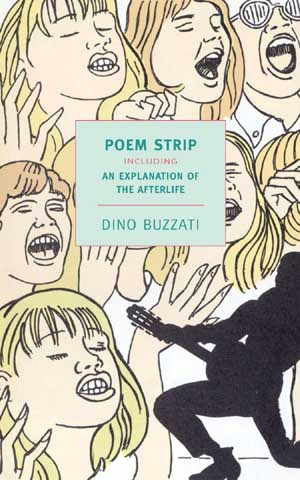
Sometimes a book comes late to the party. It walks in bearing beer and waving a hot new album it’s discovered, to find that very CD blaring from the stereo and the guests already drunk. That’s Poem Strip, Dino Buzzati’s graphic novel retelling of the Orpheus myth. I gather Poem Strip was an important comic in Italy; according to one review it was the 1970 winner of the Paese Sera Best Comics of the Year Award. But in English Poem Strip made its first appearance in 2009, and entered like an aging swinger who’s never revised his mustache and still wears forty year old polyester bell bottoms.

Here’s the problem: Poem Strip is absurdly, distractingly sexist. Buzzati drew many pictures of women for this book, and most are at least half and generally some smaller fraction of naked, and even while ushering guests down staircases or staffing the front desk in an office they tend to pose as though for girlie mags. Derek Badman, in his review at MadInkBeard, speculates that these women were in fact traced from girlie mags. He also complains that some of Buzzati’s drawings are crude. I think we have to cut the guy some slack on the art; he was obviously drawing one-handed. It’s a lot like the often-adolescent and now mostly embarrassing underground comics of the 1960s; you get the sense that this is the work of a guy who’s just realized standards have opened up to the point that he’s allowed to publish sexy drawings, and in all the excitement has forgotten that sometimes it’s better not to.

Much of the early part of the book is taken up with a song from Buzzati’s Orpheus—here a rock star named Orfi—called “Witches in the City.” Orfi alternates paranoid ramblings about all the women he thinks are out to seduce him with chanted litanies of names—“Barbara Yvonne Leda Fiorella,” et cetera, as though implicating the entire other half of the human race. Not only are women sirens luring men onto sharp rocks, they’re all in on it together, man. I hope Buzzati got into therapy at some point.

It’s too bad Poem Strip is hiding behind this huge stumbling block, because there’s also a lot to like. Stylistically, it looks like a collaboration between Fredrico Fellini and Glen Baxter, colored with a limited palette. Buzzati references Fellini directly at one point, as well as Murnau’s Nosferatu, Arthur Rackham, and a number of other artists who he credits in his brief forward. He fits his style to the tone of the page, swinging from realism to expressionism and back and still managing to keep Poem Strip a unified whole.

You know the story (at least, you should). Orfi, despite his weird gynephobia issues, has somehow managed to keep a relationship going with Eura. Who dies. In case you hadn’t guessed, this is Euridyce. So Orfi follows her into the underworld, reached through a strange door in the Via Saturna. He’s met by a talking overcoat that at one point calls itself “Kruschevian.” An interview with the translator confirms that the overcoat is a reference to the Soviet premier but unfortunately doesn’t explain the connection. (I wish Poem Strip had a new introduction, or maybe some footnotes.)

Life, in the overcoat’s view, is like an ocean whose tides are set by death’s huge gravitational pull. In the afterlife, the absence of death creates a different emotional landscape. The dead can’t die again, can’t be injured and have no need for physical pain, so they have fewer things to fear. They have less to lose, and fewer reasons for sadness. With all of eternity to play with, anything can happen; life’s possibilities never close off. Knowing the answers to the ultimate questions, they have no sense of the uncanny. They have no need to pass on their genes to a new generation, so no need to feel passion.

To placate the dead Orfi sings to them about what they can no longer feel. This is the best and most substantial passage in the book. Buzzati illustrates an old man who “checks his mailbox for the hundredth time but there’s nothing there,” dried leaves on the wind forming “strange ghosts in the sky,” a bogeyman floating over the city. Every image gets at least a page to itself. The art here is mostly at the expressionist end of the scale, as much designed as drawn, and weirdly evocative. A thing that rises by the side of the road and reaches out to a traveler is depicted pretty much as a blob, but it’s scary as anything.

Finally, Orfi finds Eura, and loses her again—but not the way you’re thinking. This is where Buzzati kind of redeems himself in terms of gender politics. Usually this myth treats Eurydice like the rope in a tug of war. She dies, Orpheus drags her out from Tartarus, then she’s yanked back because of something Orpheus does. But in Poem Strip Eura refuses to follow Orfi out of the underworld at all. Eura doesn’t mind being in the afterlife. She’s in the right place. She’s dead.

And maybe, Eura hints, the afterlife isn’t a cold, passionless place after all. Love is not absent, and she and Orfi will be together again when the time is right. It’s Orfi who’s yanked away from the flatly prosaic afterlife to the land of the living. Poem Strip returns to the themes of Orfi’s song in the last few pages, depicting swirling storms and “turreted clouds of eternity.” the disturbing, uncanny world of the living goes about its business as Orfi stands in the Via Saturna, holding the promise of Eura’s ring.

Links to Things

  • From the New York Times, why English is a great language for newspaper headlines with accidental double meanings.

    Since English is weakly inflected (meaning that words are seldom explicitly modified to indicate their grammatical roles), many words can easily function as either noun or verb. And it just so happens that plural nouns and third-person-singular present-tense verbs are marked with the exact same suffix, “-s.” In everyday spoken and written language, we can usually handle this sort of grammatical uncertainty because we have enough additional clues to make the right choices of interpretation. But headlines sweep away those little words — particularly articles, auxiliary verbs and forms of “to be” — robbing the reader of crucial context.

  • Here’s another New York Times article that interested me simply because it introduced me to a new word:

    In a 2004 essay, he coined a term to describe it: “solastalgia,” a combination of the Latin word solacium (comfort) and the Greek root —algia (pain), which he defined as “the pain experienced when there is recognition that the place where one resides and that one loves is under immediate assault … a form of homesickness one gets when one is still at ”˜home.’”

  • Catherynne Valente explains what publishers do, and why books are not cheap, and why, no matter how long Kindle owners hold their breath, they’re not getting cheap ebooks or a vibrant self-publishing industry anytime soon:

    I’ve read the slush pile. And in this Orwellian post-publishing dystopia, you will be, too. The mass of ebooks will be unedited, badly written, and horribly presented. And while this is an unpopular thing to say, that’s pretty much the state of self-publishing now. There are a few great self-published projects, and they are buried in an Everest of trash. Essentially, a reader acts as an acquiring editor, sifting through the mediocre, offensive, awful, and laughable for one good book. And readers will usually give up after a few burns.

  • Ann Leckie, on how stories shape thinking, and why we therefore need to think about what stories mean:

    The way to have control over how the metaphors and stories you ingest affect your thinking is to know they’re doing it and to be aware of how they’re working. You have to think about them to do that, have to question them. If you’re a writer, in my opinion you should be doing that as a matter of course, just to improve your abilities. If you’re not a writer, well, pick your own level of analysis. If that’s just “Squee!” fine. But just because you don’t see the subtext doesn’t mean it isn’t there, and worth questioning.

  • Finally, Dan Nadel has new information on Herbert Crowley, the cartoonist who created one of the most interesting entries in Nadel’s book Art Out of Time, the brief, bizarre strip The Wiggle Much. Unfortunately, as I write this Nadel’s current blog is having technical problems and this post seems to have vanished, but if it reappears, be sure to take a look—it included some tantalizing cameraphone photos of Crowley’s sketchbooks.

Steven Brust, Iorich

Cover Art

Once upon a time Steven Brust wrote Jhereg, a lighthearted adventure starring Vlad Taltos, a human assassin and organized criminal living among the Dragaerans (basically long lived elves). Some of that book’s fans would have been perfectly happy to watch Vlad smart-assedly knife his way through a whole series of cookie-cutter sequels.

Luckily for the rest of us Brust was up to something more interesting. A couple of volumes later, in Teckla, the situation set up in Jhereg got knocked down and Vlad started asking himself the kind of hard questions fantasy crime lords can’t ask themselves and still end a long day of organizing crime with an untroubled night’s sleep.

If you haven’t read Brust, Jhereg and Teckla may look like nonsense words. They’re three of the seventeen houses of which all Dragaerans are members. The houses are a kind of caste system: every house’s culture embodies a piece of Dragaeran society (including pieces, like the criminal Jhereg, they’d rather do without) and every house gets a turn running the empire according to its own principles. The houses are named after Dragaeran animals, and the Vlad Taltos books are named after the houses1, and in each book Vlad has to think like a member of that house to solve a problem, and sees the world from its point of view. Vlad is touring the empire house by house, and his moral education progresses through what he learns along the way. (Jo Walton has written good introductions to the Taltos series and Dragaera in general at Tor.com.)

Iorich is the twelfth book in the series. The house of the Iorich provides Dragaera with its lawyers and judges, so here Vlad’s immersed in the legal system. He’s investigating why a friend of his has been arrested under one of those “technically on the books, but it’s not enforced unless you’re really obvious about it” type laws. Except she wasn’t obvious about it; she’s been arrested for reasons that are too complicated to explain in a book review, and are in any case spoilers.

When Vlad was a criminal, he saw the law as a barrier to evade. Now he discovers his enemies using the law as a tool to get what they want–even if what they want is contrary to the purpose of the law.

Let’s take a little side trip back to the real world. You often hear people complain that the law isn’t written in plain english. Why are the bills creeping through Congress a thousand pages long? Why do lawyers and legislators spend paragraph upon droning paragraph defining, in minute detail, the meaning of everyday words like “vehicle?” Everybody knows what a vehicle is, so why not just say “vehicle?”

Because it’s difficult to get people to understand what “vehicle” means when their self-interest depends on not understanding it. If the law did not carefully and precisely define what it meant by “vehicle” then every idiot hauled into court over a vehicle-related dispute would have their own argument as to why, in the case of their own personal vehicle-like object, the law didn’t apply.

Language is messy. Dry and convoluted legal language is a linguistic junk drawer organizer. It sorts the mess into neat little cubbyholes and reduces the wiseguys’ ability to interpret the document however they like.

But no matter how detailed and orderly you get, language is not computer code and people are not functions. It’s impossible to write a law so perfect that somebody can’t misuse or misinterpret it. Outlaw torture and sooner or later someone will write a legal opinion pretending that when they torture somebody it’s somehow okay. The law doesn’t prevent injustice; it just makes injustice harder to pull off. Which is why we need courts and lawyers and judges to keep an eye on each other. As Vlad’s lawyer puts it:

But, you know, there is making the law, and enforcing the law, and interpreting the law, and they all mix up together, and it’s people who do those things, and the people all mix up together. You can’t separate them.

Which is not to say that Iorich is a heavy tome. Like almost all this series, it’s written in First Person Smartass. (The source of this term is not clear, but it seems to be everybody’s first description for this series, and it’s useful for all kinds of books besides.) Vlad’s voice reminds me of Archie Goodwin’s from the Nero Wolfe novels by Rex Stout. (The family resemblance is enhanced by the loving attention with which Brust writes about food. Dzur, for instance, is organized around a meal at the most kickass restaurant in Adrilankha.) Iorich, like every other book in this series, is a just-one-more-chapter novel. I’m always disappointed when the chapters run out.

I’m not loving the cover, though. It kind of looks like a box of Dragaeran Frosted Flakes.


  1. Mostly. The book that takes place earliest in Vlad’s life is Taltos, and the word is that Brust plans a final, nineteenth, volume called The Final Contract. ↩

Paul McAuley, The Quiet War

Cover Art

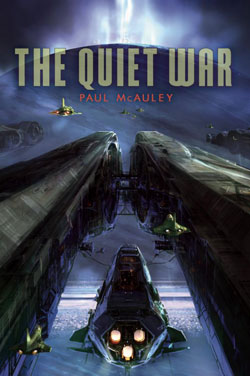
The Quiet War thinks people are no damn good. It’s set a couple of hundred years in the future and citizens of human colonies on the moons of Saturn are evolving themselves into posthumans. This is a common theme in SF. One of the genre’s ongoing projects is an expansion of the definition of “human.” But most people back on The Quiet War’s Earth would rather not have their definition expanded, and the more radically posthuman colonists think unmodified humans are uncouth genetic throwbacks.

Late in the book one character talks about ring species. Ring species are unusual species which trick you into watching a creepy videotape and then, seven days later, jump out of your television. No, wait. Actually, ring species are species which live in a ring-shaped habitat. At the two ends of the ring are distinct species, so different they can’t interbreed, but in between are a series of interbreeding populations, each a little different, gradually shading into the two species on the ends.

The Quiet War sees humanity defining itself as this kind of continuum, othering the ends of the continuum, and declaring war.

The thing is, Earth and the colonies don’t know why they’re going to war. The powers that be—the monarchical families that rule earth, and the influential personalities who guide public opinion in the direct democracies of the colonies—think they’re going to war for revenge, for resources, for philosophical differences, or for control of the solar system. But at bottom, they’re going to war because even the leaders who have the people under their thumbs are themselves under the collective thumb of the mob… and the mobs hate each other’s guts.

No matter where you are in the solar system, humanity in The Quiet War gets meaner and stupider in the aggregate. And it won’t stop with one war: wipe out the people at the ends of the ring, and the people left in the smaller ring redefine the new ends as not quite human. Repeat the process long enough, and there’s not much of humanity left.

So, yeah, grim. And not necessarily what I needed to read coming out of winter. (Could we please have more SF about cool futures? You know, where most people are basically going to be okay? It’s not like an utter dystopia is a necessary prerequisite for conflict and drama.) It didn’t help that of the five point-of-view characters, four were, as far as I was concerned, villains.

But I still read the whole thing—enough to find out that, luckily, the single sympathetic POV character gets a happy ending, and most of the few other characters I cared about made it through all right. The Quiet War is a decent thriller. Paul McAuley’s prose isn’t earth-shatteringly beautiful—what I look for in prose are “I never thought of it that way” moments, the bits where some observation, word choice, or turn of phrase makes me think of whatever’s being described in a new light. But The Quiet War isn’t badly written, either; it’s what readers suspicious of highfaultin’ lit’ry stuff call “transparent prose,” and a better than average example of the form.

If The Quiet War has a problem, it’s that McAuley is sometimes too anxious to show us his research. Technical detail is good—this is hard SF, after all—but McAuley gave more detail than I needed, or cared, to know. A small, typical example occurs in a battle scene when a dead soldier’s body is frozen to be sent home. McAuley is careful to inform us that he’s frozen at two degrees Celsius. Why do we need to know the exact temperature? You could slim this thing down by fifty pages, and be left with a better book, just by cutting the excess technobloviation.