Monthly Archives: January 2010

Sarah Caudwell, The Sirens Sang of Murder

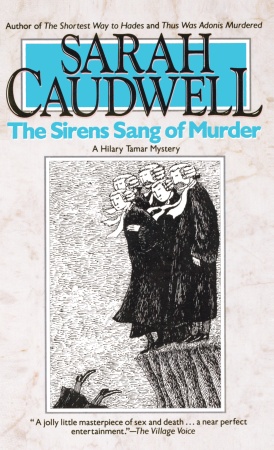
Cover art, by Edward Gorey. Because Hilary Tamar is just that cool.

(Note: I’m posting about a mystery novel. I don’t reveal the killer, but it’s almost impossible to talk about a mystery novel without spoiling something. If you’re planning to read this book, proceed with caution.)

The thing that usually gets mentioned when people talk about Hilary Tamar, the legal historian/amateur detective who appeared in four novels by Sarah Caudwell, is that we never learn Hilary’s gender. You might assume from the emphasis placed on that fact that these books spend a lot of time teasing the audience. Actually, it’s the least noticeable or interesting thing about them. Most readers probably get a pretty good mental image of Hilary from his/her narration, even if it’s a different image for everybody. Hilary is big on literary references and hangs out in wine bars with a group of young British lawyers whose misadventures provide him/her with cases, so my mental image of Hilary looks exactly like Horace Rumpole.

Caudwell wrote books in the form of classical detective tales and the style of P.G. Wodehouse (with a little extra frankness about sex). They’re painlessly loaded with the lore of British estate and tax law. The Sirens Sang of Murder, the third in the series, is set in various offshore tax havens. The plot is driven by the absurd lengths to which British millionaires go to avoid taxes, and I actually managed to sort of understand the arcane legal contortions. Caudwell wrote the kind of books that make me feel smarter while I’m reading them.

The Sirens Sang of Murder is set at a specific point in time technologically: the solicitors’ office has just installed a Telex machine, sort of a telegraph hooked up to a typewriter. Michael Cantrip, one of the more airheaded regular cast members, is nuts about it and narrates most of his scenes through his voluble telexes. A few years later he’d have sent faxes, and later still emails.

At one point another regular, Selena Jardine is unhappy with one of the clues—a distinctive pen dropped at a murder scene. It’s old-fashioned, something out of an old detective novel, and she doesn’t find it remotely believable. “People do what books have taught them to do and feel what books have taught them to feel—it is curiously difficult to do otherwise,” observes Hilary. Selena thinks about crime as realistic modern police procedurals taught her to do.

In the real world, lawyers complain about the “CSI effect”, the assumption by jurors that forensic science works just as magically as it does on TV. Stories have power. Everyone sees the world through the filter of the stories they read and watch and listen to.

Sirens’s cast is focused on the financial shenanigans surrounding the Daffodil Trust. They’re looking for a realist motive, a motive that makes some kind of sense. They miss one obvious possibility because it’s intruded into their narrative from romantic (in the archaic sense) literature. The real killer has been reading different books.

We in the audience, as real people reading a mystery novel, can’t help looking at Hilary’s case through the lens of detective fiction—because, heck, it is detective fiction. At one point, a revelation pointed to one obvious suspect who appeared to fit all the clues, some of which had been laid very subtly, very early on. I knew he was a red herring. I hadn’t worked this out through a Holmesian deductive leap. I just had information that Hilary didn’t: I knew I was only two-thirds of the way through the book. What kind of crappy detective novel would reveal the killer with 80 or 90 pages left to go?

Links to Things

Here’s another list of interesting links I’ve collected recently:

  • Jo Walton, at Tor.com, on science fiction reading protocols:

    We talk about worldbuilding as something the writer does, but it’s also something the reader does, building the world from the clues. When you read that the clocks were striking thirteen, you think at first that something is terribly wrong before you work out that this is a world with twenty-four hour time–and something terribly wrong. Orwell economically sends a double signal with that.

    And an earlier essay on the same subject by James Gunn:

    Earlier in the essay, Delany refers to the fact that “the conventions of poetry or drama or mundane fiction–or science fiction–are in themselves separate languages,” and in other essays call the process by which one approaches and reads those languages as “protocols.” As I thought about it, I realized that good reading is a matter of learning the protocols and applying them with understanding and sensitivity to a particular genre: poetry, for instance, is not read with the same protocols as prose, or an essay, as an article, or a short story, as a novel, or any of these, as drama.

  • On the other hand, there’s this post from another writer in which “genre fiction” is pitted against “literary fiction,” and the Virginia Quarterly Review is held up as an example of all that is wrong with the literati. There are people who look down on genre fiction–David Langford finds one or two examples every month for Ansible–but hardly anyone listens to them anymore and it’s really time for genre fans to stop obsessing over it.

    But I’m linking to this particular post because, rather wonderfully, the editor of the Virginia Quarterly Review shows up in the comments to point out that the VHQ does, in fact, publish genre fiction. I think this is what the kids these days call “pwned.”

    Elsewhere, Rachel Swirsky explains the difference between genre as a tool and genre as a prophecy.

  • Ten ways to write badly. I only draw comics and write blog posts, but I must admit I’m guilty of the first half of rule 7 (“Write only when the muse moves you.”) Got to work on that.

    Additional rules for writing badly, the way I write badly:

    11. Adverbs are your friends.
    12. So are semicolons.
    13. Em dashes! Lots of em dashes!
    14. Interjections are so much better than actually organizing your thoughts.

    Too much of the time I spend revising blog posts is spent just cutting down on these four problems.

  • Much of the art in the Louvre is anonymous. Who made it? And what assumptions do we make about the people who made it, and why do we make them?

  • On a less tasteful note, this is what can happen when language changes.

Cory Doctorow, Makers

The cover art for the British edition, which looks so much better than the American cover.

One complaint I hear from people who don’t like science fiction is that it’s about ideas and not people. Given the amount of SF I read I obviously don’t agree, but even I think they sometimes have a point–about Cory Doctorow’s Makers, for example.

For me, Doctorow is a love-it-or-hate-it writer. His best book is Someone Comes to Town, Someone Leaves Town. Unlike his other novels, Someone is a surrealist fantasy. Maybe that helped. Writing about a guy whose parents were a mountain and a washing machine, Doctorow has fewer occasions for awkwardly wedged-in futurist polemics about technology, copyright, and geek culture.

In Makers Doctorow writes about lots of things–solutions to the obesity epidemic (which lead to new and worse problems), clever uses for RFID tags, amusement parks–but mostly about a new economy where 3-D printers and cheap computers let small startups compete with bigger companies, and how to transition from here to there. And Makers’s characters pontificate endlessly on these subjects, and as they do so they sound just like Doctorow’s nonfiction.

Makers doesn’t have characters so much as mouthpieces. Everything its characters say is a speech. Everything they do is a demonstration. Some characters are good examples who embody Doctorow’s ideas. Some are bad examples. None feel like people. I never was able to keep Lester and Perry, Doctorow’s two geek heroes, straight.

Makers is weirdly Ayn Randian in its style of argument if not its worldview. (Doctorow is similarly keen on the kind of economics currently and not always accurately characterized as “free market,” but while Rand dreamed of a world ruled by captains of industry Doctorow sympathizes with ordinary people and believes the best ideas come up from below.) One of the villains is a journalist the heroes call “Rat-Toothed Freddy.” Not only does he question Makers’s worldview, but like Rand’s villains he’s ugly and petty and makes his case as offensively as possible, with gratuitous personal attacks.

Freddy doesn’t learn anything because he’s the bad guy, and Lester and Perry don’t learn anything because as the book begins they already embody Doctorow’s ideals. The last we see of them it’s years later and they’re back to their old tricks. The only character who ends the story as a better person is the second villain, Sammy, a midlevel Disney executive. At one point Makers states “Lester came to understand what it meant to be responsible for people’s lives.” But that’s something we’re told, not shown. We don’t feel what Lester is feeling, and after his moment of revelation he acts pretty much the same. At the climax of the novel the “good guys” do the right thing, the thing that solves everyone’s problems, only because it gives them a chance to humiliate Freddy.

There’s a moment, somewhere around then, when Lester (or was it Perry?) has a brief flash of insight and wonders whether Freddy has a point. Then it’s gone, and he worries no more. Which is too bad. Sometimes, Freddy does have a point. He’s the only character willing to question Makers’s worldview, and there are questions Makers ought to ask of itself, and doesn’t.

How easy is it for people who’ve dedicated their lives to a company to pick up the pieces after their jobs blow away in a hurricane of “creative destruction?” Lester and Perry’s associates skip from job to job with songs in their hearts, but for some people the stress of having their cheese moved on them all the damn time takes years off their lives. How many little startups can the market support? (Maybe not so many, given how quickly the New Work implodes.) What happens to the people whose companies fail? What about health insurance? (There’s not much sign that Makers’s America has solved its health care problems.) In practice, much of the New Work produces tchotchkes, bric-a-brac and dime-store kipple–to borrow William Morris’s rubric, things neither useful nor beautiful. How liberating is the New Work if people are still just selling each other junk they don’t need and don’t really want?

On the other hand, I do admire Makers for making kipple look fun. Makers succeeds at one thing: celebrating making. Makers respects people who do things, and do them well, regardless of who they are.

Sammy’s salvation lies in coming up with an idea he cares about, and although the Disney corporation in general serves as a villain Makers allows its good-guy journalist, Suzanne Church, to be impressed by the pride and attention to detail of the people who build and rebuild Disney World.

Of course, the Disney workers have something the Makers don’t: stability. There’s an idea floating around, courtesy of Malcolm Gladwell, that to really master a craft you need to spend 10,000 hours doing it. (Which may be why I’m great at my job, but less great at the things I love to do when I’m not at work. I need to work on my attention span for my hobbies.) 10,000 hours is a glibly arbitrary number, but it’s true (even with simpler tasks like selling electronics, as Circuit City discovered, to their cost, after they laid off their most experienced employees) that you’re more likely to find expertise in places where people have the job security to concentrate on mastering their trade.

In Makers‘s New New Economy of laissez-faire, layoffs, and dizzyingly rapid boom-and-bust cycles, just surviving takes half of everybody’s energy. Energy they could be using to, y’know, make things.

R. O. Blechman, Dear James

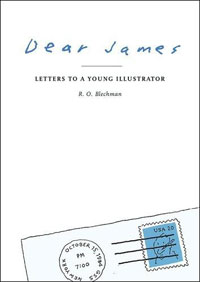
Cover Art

Dear James is R. O. Blechman’s entry into the “Letters to a Young Something-or-other” genre which has sprung up in imitation of Rainer Maria Rilke. In recent years books have been addressed to young mathematicians, young activists, young conservatives, and young novelists. The McSweeney’s website offers “Letters to a Young Plumber” and although I have not investigated this phenomenon in detail it would not surprise me if someone had written letters to a young rat-catcher.

No one seems to be writing letters to old people. It’s sad.

Anyway. Blechman is writing to a young illustrator. Not a real young illustrator, in this case, so it feels a little weird when he compliments his imaginary correspondent on his latest gig. But the conceit frees Blechman to take a casual, conversational tone and the book is more fun for it. That probably has a lot to do with why the “Letters” format has been popular lately.

Blechman touches on all the stages of an illustration from idea to print, and wider philosophical issues about art (How do you juggle creativity with a day job? What’s the difference, if any, between high art and low? And why are we doing this at all, anyway?). One idea that will be obvious to most artists but new to some readers is that art is work.

Not everybody gets this. For instance, there are people who think writers just sit down and, y’know, write. (There are writers who thing people just sit down and write. Recently I came across a blog post by a writer who claimed writing wasn’t work, it was just typing. I made a mental note to avoid his books.) These are the people who end up self-publishing horrid first-draft novels about elven vampires and cluttering slushpiles with nonsense.

There are people who think cartoonists and illustrators just draw. Maybe they’re especially fooled by scribbly and deceptively simple art like Blechman’s… but he wrestles with his ideas, draws multiple versions of an illustration, worries about the best and clearest way to communicate what he wants to get across. In one case, even after an illustration is accepted by the New York Times, he decides he hasn’t done his best work, and before the deadline he goes back to the editor with something better. It’s a struggle, but he’s also having fun. Dear James manages to communicate both the struggle and the fun.

Overheard in the Last Few Months

Sometimes I overhear odd things. I’ve been collecting these on Twitter.

  • “When the squirrel started crying his ears hurt.”

  • “…He looked exactly like me. And in a few days he was picked up by a private jet…”

  • First guy: “You’re like Superman flying backwards around the world.”

    Second guy: “You’re like…”

    First guy: “Shotgun!”

  • A mother to a whiny toddler: “You’re not being very rainbowy.”

  • In a bookstore, an older woman: “I’m looking for Farland.”

    A younger woman, maybe her daughter: “Oh, you have to go by name?”

  • In the same bookstore, someone’s opinion of Neil Gaiman: “He’s a new writer… I’m not sure I like his style. It’s very harsh and now.”

  • In a different bookstore: “It’s not just a monkey book, it’s also about conservation.”

  • Husband (enthusiastically): “Do you like fried okra?”

    Wife (sternly): “No, I do not.”

    Husband (plaintively): “Why?”

  • Kid: You wanna buy coffee table books?

    Other Kid: Let’s do it!

    Younger Kid (confused): Coffee table?

Kenneth Fearing, Clark Gifford’s Body

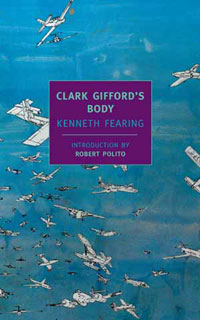
Cover Art

I’m starting to write reviews again. I’m not entirely convinced by this one, but at some point I have to stop fiddling with it, so here it is.

Clark Gifford’s Body is an obvious reference to the old song about John Brown, who sparked the Civil War with his raid on Harper’s Ferry. (Which may have been a blessing in disguise; arguably, only the war could have put an end to slavery in anything like a reasonable amount of time.)

A hundred years later, in the far-flung year of 1959 (Clark Gifford’s Body was published in 1937; no explicit date is given for the raid, but, as Robert Polito points out in the introduction, it’s not hard to work out), Clark Gifford and his “Committee for Action” seize radio stations across the country–Gifford himself takes WLEX in Bonnfield–and spark a twenty-year civil war.

The New York Review Books Classics edition of Clark Gifford’s Body demonstrates the importance of typography–in this case, the importance of getting the page numbers right. The page numbers are in the same font as the text, printed at the same size, located just under the text, where the next line would be, if there were one. So on the left-hand page my subconscious was constantly interpreting the page number as part of the text, and I kept getting knocked out of the story by phrases like “The short-wave of a number 200 of local stations…”

Kenneth Fearing wrote Clark Gifford’s Body in fragments. Narrative islands, written in different styles from different points of view, form a bigger picture like the dots in a pointillist painting. The sketches are set up to thirty years before and thirty years after Gifford’s raid. It’s a history of the future.

As such, Clark Gifford’s Body is technically science fiction. It may not satisfy many SF readers: socially and technologically, the future looks a lot like 1937. I’m willing to forgive. Within the story, we have a limited view of this society, and that twenty year civil war would not have laid a smooth road for the march of progress. In more critical terms, this kind of near-future SF is really about the present. Kenneth Fearing wrote Clark Gifford’s Body about his own world.

Continue reading Kenneth Fearing, Clark Gifford’s Body