Monthly Archives: September 2009

Mistborn: Not Quite Awful

Cover Art

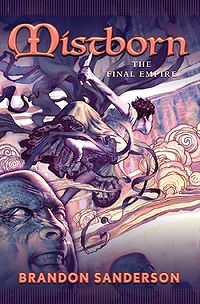
So how many aspects of good writing can you hack out of a Big Fat Fantasy and still have something I’m willing to read through—or at least skim through—to the end? Thanks to Brandon Sanderson’s Mistborn trilogy, I now know the answer: almost all of them.

By any sane standard Mistborn is ninety percent pabulum. The prose is the written equivalent of an oatmeal-on-wonder-bread sandwich. The dialog is subtly unlike anything any human would actually say, but that’s understandable; the characters aren’t people so much as mannequins pushed around a chessboard by an army of tiny robots. The little narrative details that, in a good novel, give rise to its most memorable and vivid images are too ordinary to recall. There is humor—for a trilogy that builds to a total apocalypse, Mistborn is charmingly unwilling to sink into the kind of unrelieved bleakness that battered me into giving up on George R. R. Martin after four bloated books—but I only know it’s humor because, like a long-lost Wonder Twin, it takes the form of humor. None of it is funny.

Then there’s the underlying worldview, with which I have Issues. Continue reading Mistborn: Not Quite Awful

The Bryant Collection

Cover Art

I haven’t reviewed any interactive fiction here in a while, partly because it’s hard to make myself write much of anything, but also because I go through phases where I’m interested in it and phases when I’m not. In recent years the “interested” phases have coincided with the yearly IF competition but recently I played Gregory Weir’s The Bryant Collection.


Gregory Weir released The Bryant Collection on April Fool’s Day, 2009 and regretted it in the morning. A lot of people assumed the game was a joke. (It was a while before I got around to playing it myself. April Fool’s jokes spring from unfunny people concocting a forced semblance of comedy out of a misplaced sense of obligation. I’ve never seen an April Fool’s joke that made me laugh, or feel anything but tired.)

Still, April 1st wasn’t a totally inappropriate release date. The Bryant Collection is the IF equivalent of Stanislaw Lem’s reviews of nonexistent novels or Steve Aylett’s biography of an imaginary SF writer. The conceit is that, at a garage sale, Weir came across the personal effects of Laura Bryant, a distant cousin about whom no one knew much except that she’d spent her career as a middle school English teacher. In her spare time Bryant wrote “story worlds,” pages of notes resembling a role playing game scenario: one person described the situation in the story world, the second described an action, and the first person consulted the notes for a response.

And, hey, darned if the syntax Bryant used for her story worlds wasn’t suspiciously similar to the Inform 7 interactive fiction language! So we have five games in one, supposedly adapted from Bryant’s story worlds: two environments (“Going Home Again” and “The End of the World”), two conversations (“Morning in the Garden” and “Undelivered Love Letter”), and a puzzle (“The Tower of Hanoi,” which is not really a Tower of Hanoi).

Continue reading The Bryant Collection