Monthly Archives: October 2009

Toyota is Lurking Under the Bed

Viral marketing and alternate reality games are the great new thing in marketing. Saatchi & Saatchi thought it had a doozy of an idea for Toytota. They’d stalk Toyota’s customers.

Unsuspecting participants in “Your Other You” would receive a week’s worth of threatening phone calls and emails containing personal details about their lives before being let in on the hoax. Theoretically the target, charmed by this merry jape, would go on to stalk someone else.

In practice, one woman was so frightened by the bombardment of craziness–apparently loosed upon her by a “friend”–that she couldn’t sleep, couldn’t stop crying, and started keeping weapons in her car. She’s suing Toyota for $10 million dollars. Toyota claims she agreed to participate, in the sense that she failed to notice something in some small print attached to an online “personality quiz”.

Apparently it never occurred to anyone involved in this thing—not at Saatchi & Saatchi, not at Toyota—that “Your Other You” might not end happily. These people have serious trouble seeing things from the perspective of other humans—if they realize there are such things as other humans.

I first read about the situation in an article from Canadian Business magazine (found via this page). Canadian Business, of course, disapproves of “Your Other You.” Because it’s a nasty thing to do to people? No, because “it’s hard to see how this could have been an effective campaign.” There is no obvious connection between scary pranks and Toyota’s brand, and out-of-character ad campaigns don’t perform well. The fake websites set up for the campaign were not the sort of sites likely to draw in people looking to buy a car. Worst of all, “Your Other You” was expensive.

Canadian Business does not at any point criticize “Your Other You” for causing terror and serious mental anguish. That, I guess, is just business. And that must be what Saatchi and Saatchi and Toyota thought, too.

I have to ask… what, exactly, are all those business schools teaching?

The Crusades Drag On

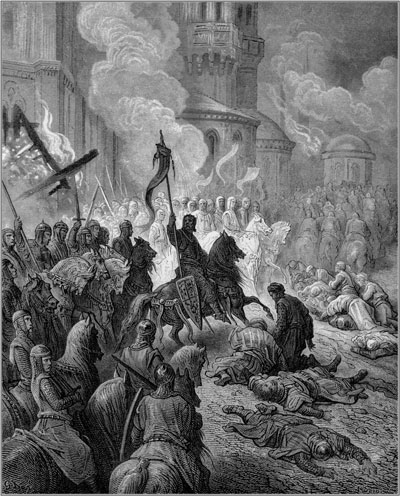
Gustave Dore does the Fourth Crusade.

When I open a book called The Fourth Crusade I sort of expect to read about the Fourth Crusade, so the preface to Jonathan Phillips’s The Fourth Crusade came as a speed bump. It’s a two-page argument that the “holy war” has no equivalent in modern Western societies—we’ve given it up for the “just war,” so good on us. It became easier to understand what the hell this was doing here when I checked the copyright. This book about a turn-of-the-thirteenth century European army whose targets had nothing to do with the stated purpose of their war would have been getting its final polish at about the time George W. Bush’s Iraq war was getting started. The preface is a troll prophylactic. “I’m not criticizing the Fearless Leader!” says Jonathan Phillips. “Honest!”

Once you’re past the prologue this is a readable layman’s overview of a war that, even by crusading standards, was pure sleaze from start to finish. It started with propaganda: a round of sermons exhorting the faithful to head out and take Jerusalem back from the Moslems. (Wikipedia gives most of the credit to Fulk of Neuilly. According to Phillips the guy didn’t actually do a hell of a lot, but I wanted to mention him because I like the name “Fulk.” More parents should name their kids Fulk, is what I say.) Some people signed on, partly out of self-interest: crusading would buy them forgiveness for their sins. Which was great, because by the time a crusade was over they’d need it. Continue reading The Crusades Drag On

Doctor Who: Managra

Cover Art

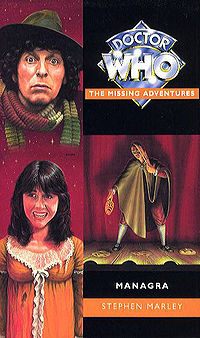
Interviewed for a Doctor Who Magazine article years after Virgin Books published his Doctor Who novel Managra, Stephen Marley recalled being “excited about what the series almost was”¦ I thought the point was to consider what it would be like were it done properly.” And, lo, the traditionalists were heard to mutter “how dare he!” On the other hand, this was exactly the point of these books as far as I’m concerned, so I’m pretty much Marley’s ideal reader.

Marley thought the Missing Adventures “went too far in terms of ‘period’ feel.” Still, Managra fits the mold of the early Tom Baker seasons produced by Philip Hinchcliffe: a gothic horror adventure centered around a charismatic madman rather than a “monster.” The difference is ambition. Managra is epic: a big world with a big story reaching back through time and the Doctor’s life, but comprehensibly human on the character level.

Doctor Who was conceived to take people from our familiar world into strange new environments, anywhere in time and space. The 1990s-2000s approach sees the primary purpose of the series as bringing time and space into a familiar world. New worlds are deemphasized; in books like The Janus Conjunction or The Infinity Race, or in the new television series, they’re spaces just large enough to contain a plot for the Doctor to foil. The inhabitants have no lives outside their purpose in the Doctor’s story.

I think we’ve lost something here. Travel between worlds enlarges Doctor Who, allowing it to move between, and colonize, new genres. Endless invasions of Earth make the universe seem smaller. Strange environments are flexible, with great scope for telling different kinds of stories (in the UNIT years, the writers feared the series might become a series of alien invasions—what we’ve seen from the last two decades of Earth-based stories). New worlds provide more space for satire, commentary (contemporary alien invasion stories usually work on the level of “pick a trend and make it evil!”), and exploration of character under unusual circumstances.

And sometimes they’re just fun.

Continue reading Doctor Who: Managra

Unseen Academicals

Cover Art

I love Terry Pratchett’s Discworld series. I will admit not every volume is a classic. The early books are shallow parodies, and sometimes Pratchett translates real-world phenomena much too closely and literally into the Discworld. I’m talking here about arbitrary pop culture, rather than institutions like police or postal services that would appear in some form in any functional society even in a fantasy world. Reaper Man is an excellent short novel about Death getting laid off and finding a job as a farmhand, which sadly stepped into a broken teleporter with a tedious short novel about evil shopping carts. The Last Continent is a pointless trudge through every “Australian” cliché in the Australian Cliché Encyclopedia. Moving Pictures—set in “Holy Wood,” fergodsakes—is the one Discworld book I’ve never been able to start, let alone finish.

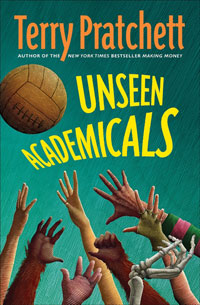
So I wasn’t expecting much from Unseen Academicals, which features on its (U.S.) cover a bunch of Discworld hands reaching for a (British) football. But you know what? It was actually damn good.

The actual football (a.k.a. soccer) content of Unseen Academicals is low. We do get a few “look, this is how [THING] is done on the Discworld” jokes; and, yes, the book does end with the Big Game, although luckily the most tedious bits are given as sportscaster commentary set off in easy-to-skip block quotation format. But Unseen Academicals isn’t so much about football as about everything around football. It’s about how sports ritualize and manage conflicts. Or fail to. It’s another variation on the Discworld series’s major project: taking a late medieval sword-and-sorcery world and civilizing the hell out of it. Lord Vetinari had banned football because it inspired riots among the more thuggish fans; the games, and the riots, have continued in the streets. As the book opens he’s realized that to keep the violence under control he has to bring the game into the open and tame it.

(The rest of this review may contain spoilers. I’ll put it behind a link.) Continue reading Unseen Academicals

The Red House Mystery

Cover Art

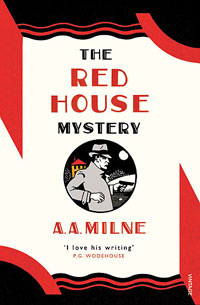
Even in childhood, my feelings toward Winnie-the-Pooh weren’t far from Dorothy Parker’s (“Tonstant Weader fwowed up”). When I discovered the existence of The Red House Mystery, A. A. Milne’s one detective novel, my head swam with visions of Death at Pooh Corner. I felt I would someday have to read it. I was certain when I realized that it was the novel that drove Raymond Chandler to write “The Simple Art of Murder”.

As Chandler pointed out in great detail, the plot doesn’t make much sense. Of course, the plots of most old mystery novels hinge on farfetched plans, weird coincidences, and generally extraordinarily unlikely events. Not being Raymond Chandler, I don’t usually notice. I couldn’t help noticing with The Red House Mystery. A Dorothy Sayers novel or an Agatha Christie novel is like a magic trick: the audience doesn’t see the magician pulling the card from his sleeve because he has something more interesting for everybody to look at. The audience doesn’t particularly want to see the card; it would spoil the show. A. A. Milne is like a stage magician who refuses to do the sleight of hand, perfunctorily walking through the trick as though he’s wondering what to have for lunch.

Take the cast. The stereotypical country house murder always happens amidst a houseful of stereotypical guests. The Red House Murder does not disappoint. Then they’re bundled back to London as soon as the body—the brother of the owner of the house, who is now missing—is discovered. For most of the book the only people around are the detective, his Watson, and the missing man’s secretary. The reader catches on pretty quickly that Milne isn’t going to do anything as clever as reveal the detective or the sidekick to be the killer, so the identity of the murderer is less than mysterious; the only questions are the motive, and how he pulled it off.

The motive is taken care of in a chapter. The inquest is in the book only to show the police being dense. Finding the method takes up most of the book and involves whole chapters of obsessing over a secret passage. The country house could be any country house in any novel, and the detective could be Psmith’s duller cousin. The Red House Mystery is a skeleton of a mystery, a mystery boiled down to the barest essentials, and clearing the meat from the bones reveals the core weirdness of the kind of traditional mysteries I love.

These mysteries take place in an alternate world where the police have trouble with complex murders and are happy to have an eccentric upper-class murder hobbyist around to solve them. Usually I accept this in the same way that I accept that the Discworld books take place on the back of a giant turtle. Usually these detectives are entertainingly eccentric, fundamentally decent if occasionally hard to get along with, and above all experts in their field. I can accept that the police turn to Lord Peter Wimsey in times of crisis, because Dorothy Sayers makes it clear from the start that he’s just that good. (Also, his brother-in-law is with Scotland Yard. Never underestimate the power of nepotism.)

I could not accept Antony Gillingham.

There are all sorts in London if you know how to look at them. So Antony looked at them—from various strange corners; from the view-point of the valet, the newspaper-reporter, the waiter, the shop-assistant. With the independence of 400 pounds a year behind him, he enjoyed it immensely. He never stayed long in one job, and generally closed his connection with it by telling his employer (contrary to all etiquette as understood between master and servant) exactly what he thought of him. He had no difficulty in finding a new profession. Instead of experience and testimonials he offered his personality and a sporting bet. He would take no wages the first month, and—if he satisfied his employer—double wages the second. He always got his double wages.

This is the point at which most readers will wish Antony Gillingham would get hit by a brick.

With all these professions under his belt, Antony doesn’t see any reason why he shouldn’t be a detective as well. Nothing to it, right? He has enough sense of self-preservation to stay away from the police and not let on he’s investigating, so we don’t hear much of the authorities’ opinion on the matter… although, to Milne’s credit, the police don’t take this random, unproven upper-class twit for granted. There’s an interesting suggestion that Antony’s injecting himself into the investigation might backfire:

It would have interested Antony to know that, just at the time when he was feeling rather superior to the prejudiced inspector, the Inspector himself was letting his mind dwell lovingly upon the possibilities in connection with Mr. Gillingham. Was it only a coincidence that Mr. Gillingham had turned up just when he did? And Mr. Beverley’s curious answers when asked for some account of his friend. An assistant in a tobacconist’s, a waiter! An odd man, Mr. Gillingham, evidently. It might be as well to keep an eye on him.

But the rest of the novel keeps the police off in the distance, and it never comes to anything.

A lot of these detectives seem to have way too much fun with their murders. Writers have ways to take the sting out of this. Sherlock Holmes doesn’t notice how he comes off half the time, so we cut him some slack. Peter Wimsey is dealing with post-traumatic stress disorder, so we know death affects him even if he doesn’t show it. The Gervase Fen novels cheerfully admit their hero’s a bit of a ghoul, and run with it. I don’t know what to think about Antony Gillingham and his faithful sidekick:

Bill brightened up suddenly.

“To-night,” he said. “I say, to-night’s going to be rather fun. How do we work it?”

Antony was silent for a little.

“Of course,” he said at last, “we ought to inform the police, so that they can come here and watch the pond to-night.”

“Of course,” grinned Bill.

“But I think that perhaps it is a little early to put our theories before them.”

“I think perhaps it is,” said Bill solemnly.

Antony looked up at him with a sudden smile.

“Bill, you old bounder.”

“Well, dash it, it’s our show. I don’t see why we shouldn’t get our little bit of fun out of it.”

This is two people getting ready to watch a man dump a dead body into a lake.

The book ends with the ever-popular “letting the killer do away with himself honorably” scene. Which is okay. it’s usually used when we’re supposed to have some sympathy for the culprit, and I guess we do in this case, inasmuch as he’s the only major character who doesn’t talk like he belongs in the Drones Club. But Antony and the police don’t have a working relationship. What on earth are they going to say when he hands over the killer’s confession? Or is he content to leave the world blissfully ignorant of what really happened?

I never think about this when I’m reading a good mystery. I never worry about any of these things when I’m reading a good mystery. I hope having watched The Red House Mystery strip the paint off the genre won’t make me look at Lord Peter funny the next time I pick up a Sayers.
IFComp 2009: Earl Grey

(This is one more Interactive Fiction Competition review.)

Earl Grey is the last IFComp game I feel inspired to review this year. Last month when I reviewed The Bryant Collection I mentioned that my interest in interactive fiction had in recent years coincided with the competition, and I’ve finally figured out why: playing through the bottom half of the IFComp game list has increasingly come to resemble reading slush. By the end of the process I’ve temporarily killed my enthusiasm for another year. Next year I think I’ll follow Emily Short’s example and ignore the games that don’t list any beta testers.

Earl Grey, though, is another good game that did not make me feel tired and sad. Continue reading IFComp 2009: Earl Grey

Vampire Science

Cover Art

All I’ve been posting lately have been Interactive Fiction Competition reviews, which have a limited audience. So I’m posting this book review I had on hand. Which is about a Doctor Who novel, and therefore also has a limited audience, albeit a completely different limited audience. Sorry.

When, in Kate Orman and Jonathan Blum’s Vampire Science, a villain sneeringly refers to Sam as “Buffy the Vampire Slayer,” it’s hard to remember that in 1997 most people thought of Buffy as a crappy Paul Reubens movie. Vampire Science slipped in at the beginning of a vampire tsunami. Anne Rice started it; Buffy and Laurel K. Hamilton built momentum; today the healthiest marketing category in SF is “paranormal romance,” the genre of hot love between vampires, lycanthropes, and assorted psychics.

Vampires usually represent one (or both) of two things: disease and sex. “Disease” is the older metaphor. For the longest time, how disease got around was a mystery. So a town had some mysterious deaths, and people dug up a corpse for some reason, and it seemed very well preserved. And it looked like the fingernails had grown, and weren’t those canines longer?  So they staked the thing. Problem solved! This school of vampirism’s most famous representative is Nosferatu’s ratlike Count Orlok.

The other strand of the mythology portrays vampirism as… ah, intimate contact (a phrase which describes both subtext and text). These vampires are hypnotically glamourous. Usually literally. It’s most famously represented by the novel Nosferatu plagiarized: Dracula. Jonathan Harker hardly has time to unpack before he’s surrounded by lovely women with interesting dental work, and I’ve never seen a version of this story in which Lucy and Mina’s trysts with the Count aren’t sexualized.

Over the past couple of decades an army of stories forcibly evolved modern vampires from seductive psychopaths into the heroines’ boyfriends. Sex has won the Vampire Metaphor War. What’s remarkable about Vampire Science, then, is that Orman and Blum found something else to do with their vampires. Continue reading Vampire Science

IFComp 2009: Snowquest

This is another Interactive Fiction Competition review.

The best games this year all do something different with setting, creating something other than caves, spaceships, and random surrealist-comedy wackylands—Duel in the Snow, Byzantine Perspective, Rover’s Day Out (spaceships and apartments are standard IF settings, but it combines them in new ways) and now Snowquest. (Which is, okay, snow again—but it’s not something we see very often, and in any case each game has a different feel.)

This shouldn’t surprise me; IF is about setting as much as anything else. Choosing a different setting isn’t enough in and of itself, of course—Gator-On shows us the Everglades, but only as a few dozen rooms with identically vague descriptions and nothing to look at. But thinking outside the usual IF boxes is a good start; it’s a sign that authors have ambitions to blaze their own trails. Continue reading IFComp 2009: Snowquest